Murder: A Leading Cause of Maternal Mortality
Firearm access is the leading driver of maternal homicides, with each 1% increase in gun ownership linked to an 8% rise in maternal deaths.

Read Time: 2 minutes
Published:
- Homicide is the leading cause of maternal death.
- Increases in state-level firearm ownership coincide with higher maternal homicide rates.
Many of us understand maternal mortality as death resulting from pregnancy or childbirth complications. This is only part of the picture. In fact, more pregnant and postpartum women die from homicides than from obstetric complications like hemorrhages or sepsis. Nearly 70% of pregnancy-associated homicides involve firearms and are perpetrated by men.
Ayesha Dholakia and colleagues conducted a study to examine how state-level changes in firearm ownership affected homicide rates among pregnant women between 2018 and 2021. They collected homicide data for pregnant women as well as state-level firearm ownership estimates from CDC databases and reporting systems. The team analyzed changes in pregnancy-associated homicides with changes in firearm ownership across 37 U.S. states.
Overall, pregnant women were much more likely to die from homicide than women who were not pregnant. The majority of pregnant women murdered in this sample were killed by an assailant with a gun. In the maps below, Map B shows state-by-state variations in these homicide events. Maternal homicides were more frequent in states with higher firearm ownership rates (Map C), suggesting assault against pregnant women rises with easy access to guns. Analysis of these geographic similarities showed an incremental relationship, with maternal homicides increasing by 8% for every 1% increase in firearm ownership.
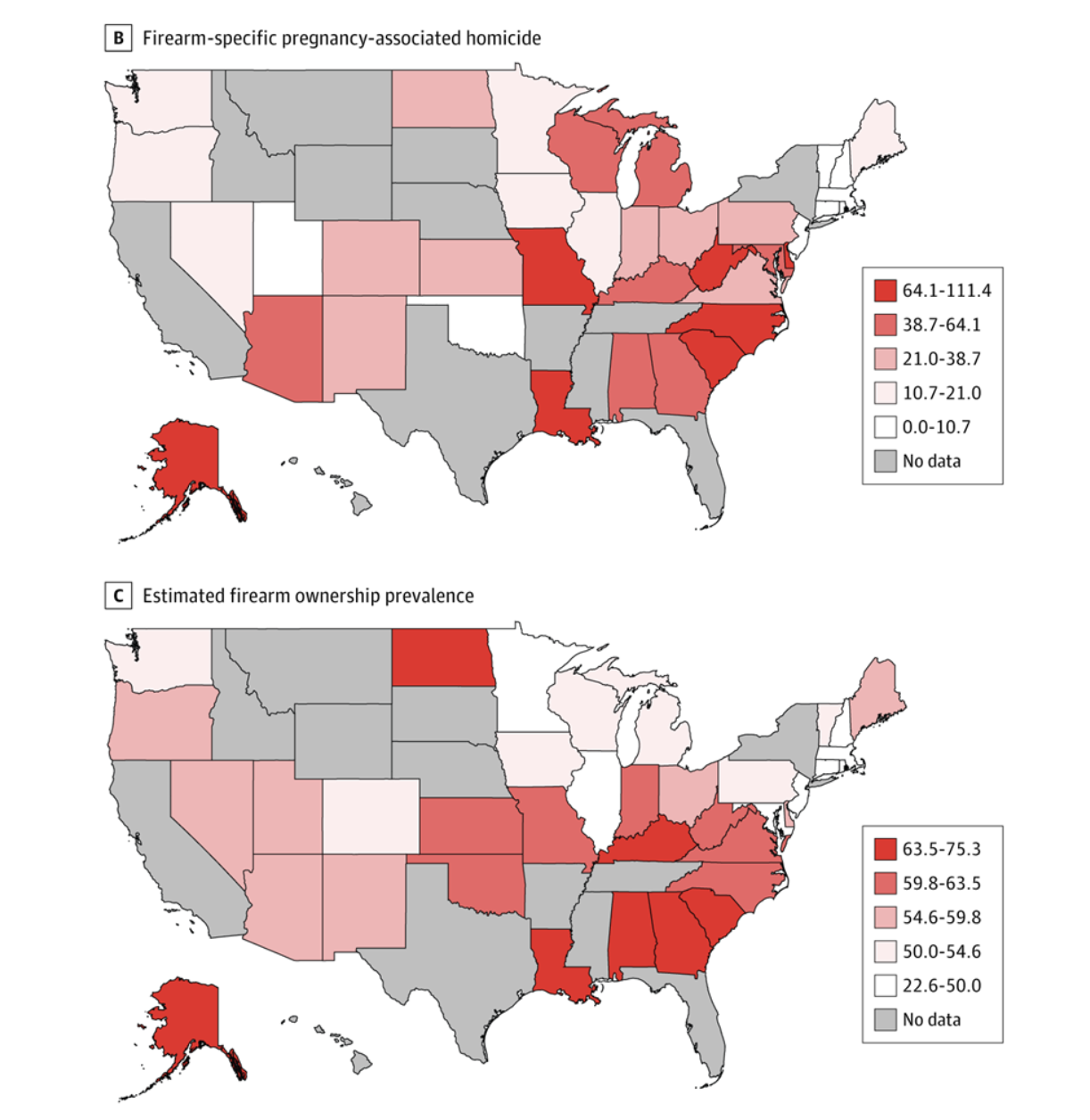
Dholakia and team urge states to enact policies that reduce firearm availability to reduce maternal homicides. For example, states can enact safe storage laws and require firearm relinquishment processes for people with domestic violence charges. Given the contentious nature of gun legislation in the United States, policy changes will likely not happen at once. However, the association between estimated firearm ownership and homicide rates suggests that even small reductions in firearm ownership may substantially lower maternal homicides.