Voter Registration for Better Health
Health care-based voter registration programs are more effective than party-affiliated campaigns in reaching eligible voters.
Read Time: 3 minutes
Published:
Public health is political. Our food and water safety, access to doctors and medication, and control of disease outbreaks are all shaped by political decisions. And in theory, those decisions are shaped by the voting population. Unfortunately, people who are underserved by public health systems, such as those living in food deserts or next to hubs of environmental pollution, are often the same groups underrepresented in democratic processes.
Ensuring that all voices across the country are heard is an important step towards creating public health policies that meet public needs. Research consistently shows that U.S. states with restrictive voting laws have worse community health outcomes than states with fewer barriers to voting. States with same-day voter registration, mail-in voting, and other policies that make voting accessible find a larger percentage of eligible voters at the polls, where they have a chance to support public health policies and health care access. The American Medical Association has declared voting a social determinant of health, highlighting its importance in driving our overall well-being.
As of 2024, over a quarter of eligible Americans were not registered to vote. As a result, many of these people have never been reached by party-affiliated campaigns or are otherwise excluded from civic participation. Health care-based voter registration may offer better access to these potential voters. Health professionals command public trust and interact with diverse, often marginalized, people on a daily basis. Thus, they are uniquely positioned to foster civic engagement; in health care settings, professionals can prepare patients to vote for their individual and community-wide health.
Research shows health care-based voter registration programs are much more effective than party-affiliated campaigns in reaching women and people of color, as well as young and unregistered voters. Vot-ER is one such organization currently partnered with over 2,000 federally qualified health centers, community clinics, hospitals, and medical schools across the U.S. to help get new voters to polls across the country. Vot-ER also facilitates the emergency absentee ballot process so patients who are hospitalized in the days leading up to an election can cast their votes.
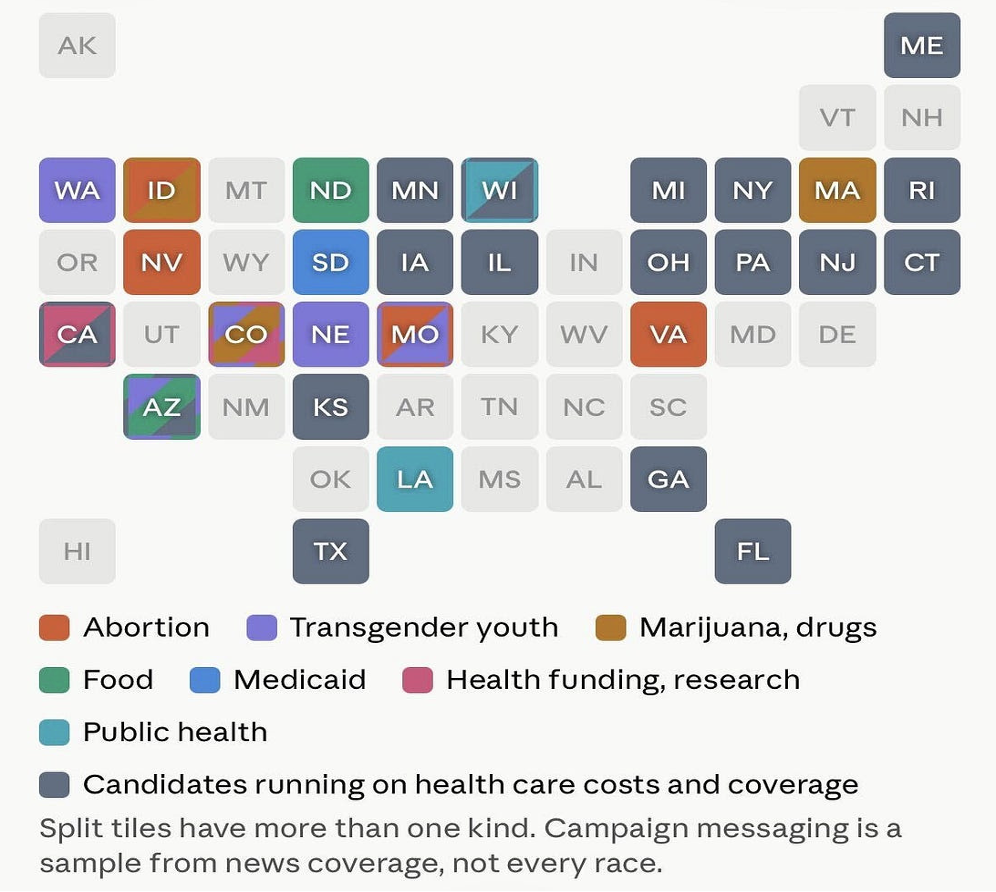
Although midterm elections are rapidly approaching, the window of opportunity is still open. Nearly 35% of registered voters did not participate in the 2024 elections. Organizations like Vot-ER can still boost engagement efforts and galvanize patients who are unlikely to vote before polls close on Tuesday. Additionally, over a dozen states, including Iowa, Minnesota, Nevada, and Virginia, allow eligible citizens to register in-person on election day before casting their ballot. As the figure below shows, each of these states and more across the country has public health issues at stake. Eligible citizens can still make their voices heard at the polls and help create better conditions for each of us to thrive.
Political participation is essential to our individual and shared agency as well as to our individual and shared health. With each election cycle, nonpartisan and community-led civic empowerment programs may play a crucial role in improving our public health. Health care spaces and other trusted community institutions can serve as effective points of contact for enlisting and mobilizing our population to vote.