Simple Toothache, Complicated Causes
Research shows that social factors influence dental health, so good oral hygiene alone may not be enough to prevent tooth decay.

Read Time: 2 minutes
Published:
- Socioeconomic factors like income and food security may affect dental health.
- Prioritizing access to dental care is an important public health intervention.
Tooth decay can mean more than just a dreaded visit to the dentist. Untreated cavities can lead to pain, infection, and difficulty eating. Dentists recommend routine dental cleanings, daily brushing and flossing, and fluoride rinses to prevent tooth decay. However, these efforts at oral hygiene may not be enough. New research suggests broader social factors, such as access to education and fresh food, may also influence dental health.
Drs. Vahan Boyajyan and Usama Bilal analyzed data from the National Health and Nutrition Examination Survey (NHANES) to explore the relationship between social factors and dental health among nearly 23,000 adults between 2011 and 2020. The authors collected data on participants’ income, education, health insurance, employment, and food security. Each participant also received a dental examination to identify decayed, missing, or filled teeth.
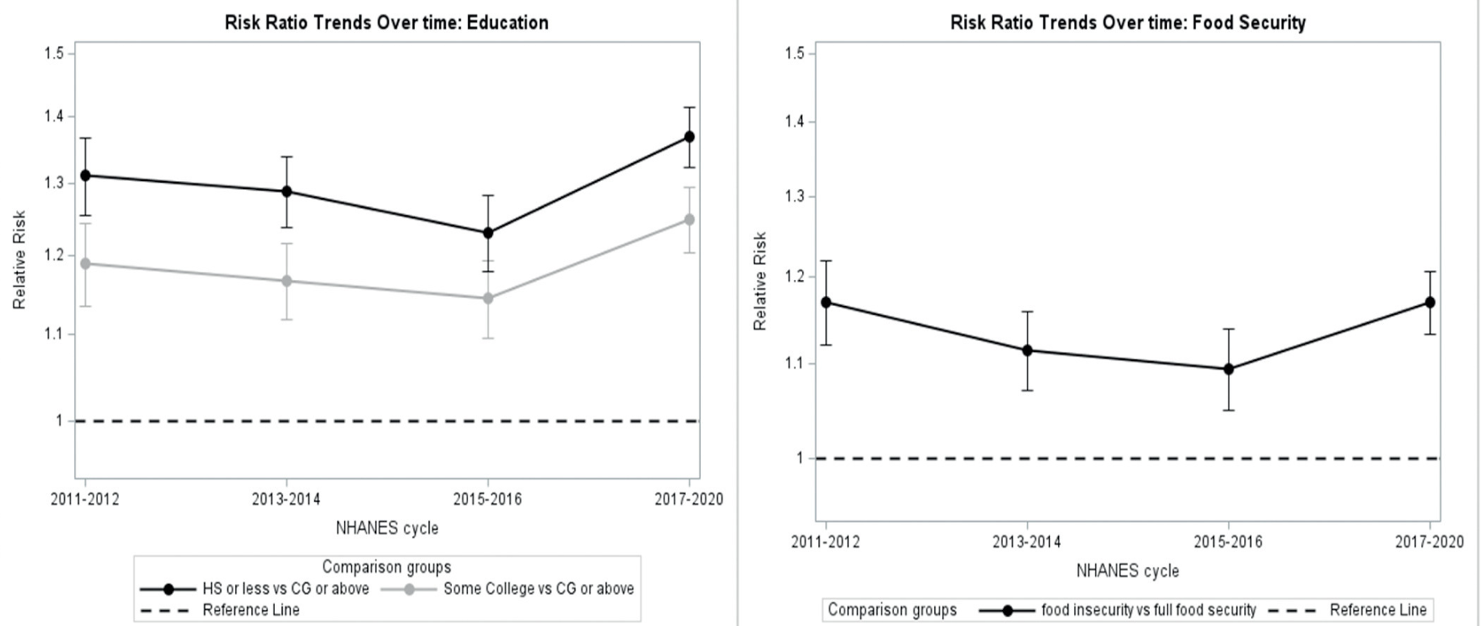
People in lower socioeconomic groups had up to a 31% higher burden of decayed teeth than people in higher socioeconomic categories. As the figure shows, the risk for poor dental outcomes (black line) has also increased since 2015 for people with no college education (left panel) and for people experiencing food insecurity (right panel), compared to people with college degrees and food security, respectively.
Factors like unemployment or food insecurity do not themselves cause poor oral outcomes. Rather, different social experiences change our exposure to known causes of dental decay. For example, low-income people are more likely than high-income people to live in communities with inadequate water fluoridation. Similarly, people who live in food swamps where fresh produce is scarce may also have an overabundance of processed sugars in their diets. Exposures in these communities may make their residents more likely to develop tooth decay.
The authors recommend state and federal policy interventions to reduce barriers to optimal oral health. Such strategies can include expanding the Supplemental Nutrition Assistance Program (SNAP) in food swamps, maintaining optimal fluoride levels in drinking water, requiring employer-based insurance plans to cover dental care, and providing access to cost-free dental clinics in low-income communities.