Posting Signs of Postpartum Depression
The language used in new mothers' social media posts may reveal early warning signs of postpartum depression.

Read Time: 3 minutes
Published:
- Depression in the postpartum period after childbirth commonly affects new mothers.
- Signs of depression can be determined from the words new mothers use when communicating online.
One in eight women across the United States experience postpartum depression. Postpartum depression is often characterized by long-lasting sadness, insomnia, and withdrawal from the baby and other family members. Initially, it can be difficult to differentiate the onset of this severe condition from expected post-delivery emotions, but the language that new mothers use when sharing their experiences online may offer some clues.
Marta Wikowska and colleagues analyzed posts on X to explore the emotions of new mothers by analyzing the words they use to describe feelings of control. When someone experiences depression, they often feel as if they have a lack of agency in their lives, as if events are just happening to them and they have difficulty starting or following through with actions and plans. These feelings of agency can be discerned through the way a person communicates. The researchers defined higher semantic agency as the use of words communicating control and intentionality, and low semantic agency by a lack of these words. For example, a low semantic agency post read, “Postpartum recovery is hard, and I’m finding it difficult to feel motivated for anything,” while a high semantic agency post read, “I’ve been exercising for about a month now, and wow, I feel great!”
The researchers paid particular attention to negative emotion words such as “worry” and “cry,” and “I-words,” or singular first-person pronouns such as “I,” “me,” and “myself.” They also monitored topics discussed, including“depression,” “health care coverage,” and “self-care.”
On the graph below, the researchers rated posts on their level of semantic agency and how often they mentioned depression. Posts discussing depression all had lower ratings for semantic agency than posts discussing other topics. One low-agency post, for example, read—“Now that I’m 3 weeks postpartum, I’m overwhelmed with feelings of anxiety, stress, and worry. It’s almost like I’m grieving my former self.”
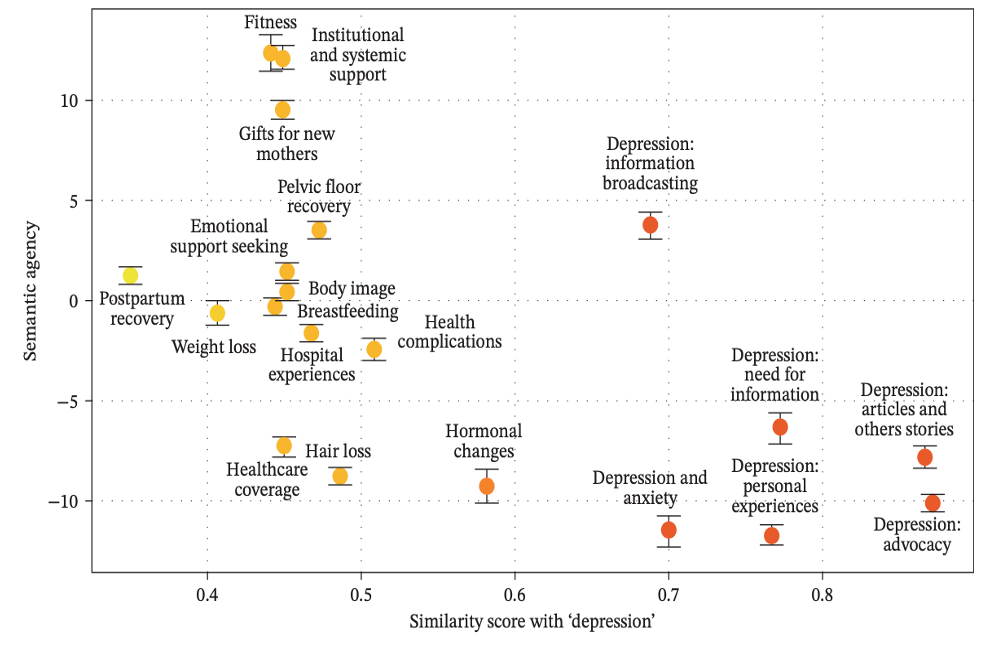
Previous research found that people with depression are more likely to use negative words than positive words when communicating about their feelings and experiences. However, the researchers did not want to rely on this measure alone, as they noted that people can experience negative emotions without being depressed. The researchers argue that combining a focus on negative language use with the amount of “I-words” and a measure of low semantic agency helps provide a more accurate way to detect signs of depression.
Many mothers can feel isolated after giving birth. As a friend or relative of a new mother, keeping an eye out for signs of depression in social media posts can serve as an early warning sign and help provide timely support when someone you know needs it most.