Suspected Drivers of the Infant Mortality Gap
The Black–White infant mortality gap is widening, with higher rates of preterm birth and sudden unexpected infant death among Black children.

Read Time: 2 minutes
Published:
- The gap in Black and White infant mortality rates has been growing since 2020.
- Different mortality rates are a product of more preterm births and sudden unexplained infant deaths in Black populations.
Babies die in infancy for any number of reasons, including infections, birth defects, and suffocation. These tragic losses are felt unequally across the population. Infants born to Black women die at twice the rate as infants born to White women. The infant mortality gap had been closing for 2 decades before the COVID-19 pandemic but has reversed course since 2020. New research investigates the likely culprits behind this change.
Monica J. Alexander and colleagues matched over 365,000 birth and death certificates for infants born to Black or White mothers to examine which causes of death accounted for differences in mortality. The team also collected pregnancy data from the National Center for Health Statistics to better understand how a fetus’ gestational age, or time spent in the womb, affected health outcomes.
Preterm births, a known risk factor for death in infancy, were the largest source of race-based differences in infant mortality rates. Between 2003 and 2024, nearly 17% of infants born to Black mothers were born preterm, or before 37 weeks of gestation, compared to only 10.5% of White infants. Had these frequencies been equal, over half of the observed mortality gap would have vanished, and thousands of babies could have survived.
However, the gap would not have closed entirely. Over the last five years, other causes of death stepped up to lead the divergence in infant mortality rates. As the figure below shows, the effect (y-axis) of sudden unexpected infant deaths (SUIDs) on infant mortality increased after 2020. SUID is a broad category of infant deaths that arise from suffocation or strangulation in bed, sudden infant death syndrome, or other unexplained causes. These causes of death are accounting for more and more of the mortality gap between Black and White infants.
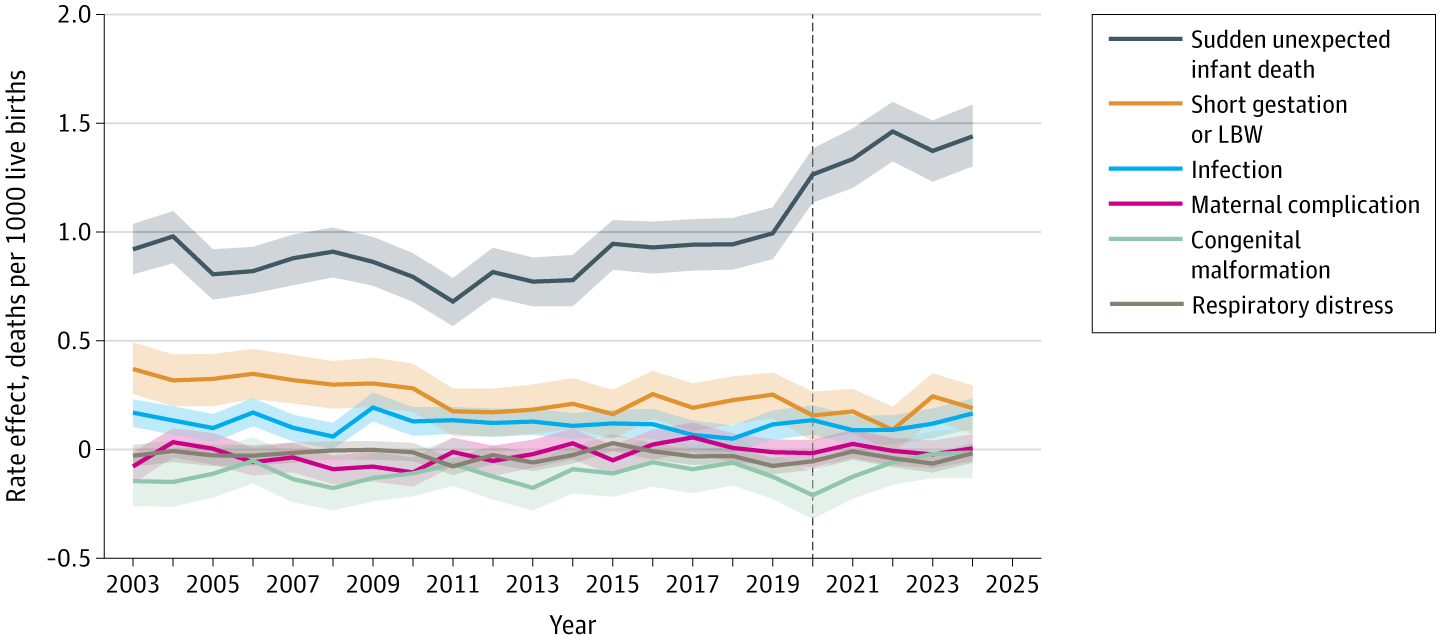
The findings suggest that even if preterm births, the largest cause of race-based differences in infant mortality, were eliminated, Black infants would still be at greater risk of death due to the growing role of SUIDs. Alexander and colleagues postulate that the rise in SUIDs during and after the COVID-19 pandemic could be a downstream effect of the respiratory pandemic and warrants further investigation. In the meantime, bringing awareness to SUIDs and common factors associated with preterm births could help save thousands of infants.