Touching Grass to Pass Class
Proximity to a park is correlated with a 5% increase in the number of students meeting or exceeding standards for academic assessments.
Read Time: 3 minutes
Published:
- Middle school students in schools near public parks have better classroom performance.
The phrase “touch grass” is commonly used across younger generations to nudge their peers to get offline and out into the real world. There’s some science behind the snark—spending time outside benefits physical and mental health. Now, a growing body of evidence shows that time spent in nature can also lead to better results in the classroom.
Lea Fortmann and Isha Rajbhandari studied the connection between a school’s proximity to a public park and the academic performance of its students. The study analyzed Washington State Department of Education data from four counties across all grades. Academic success was measured by the percentage of students who met or exceeded standards for statewide exams. In this study, spaces such as beaches, trails, and playfields were classified as parks; golf courses, cemeteries, dog parks, and private parks were not.
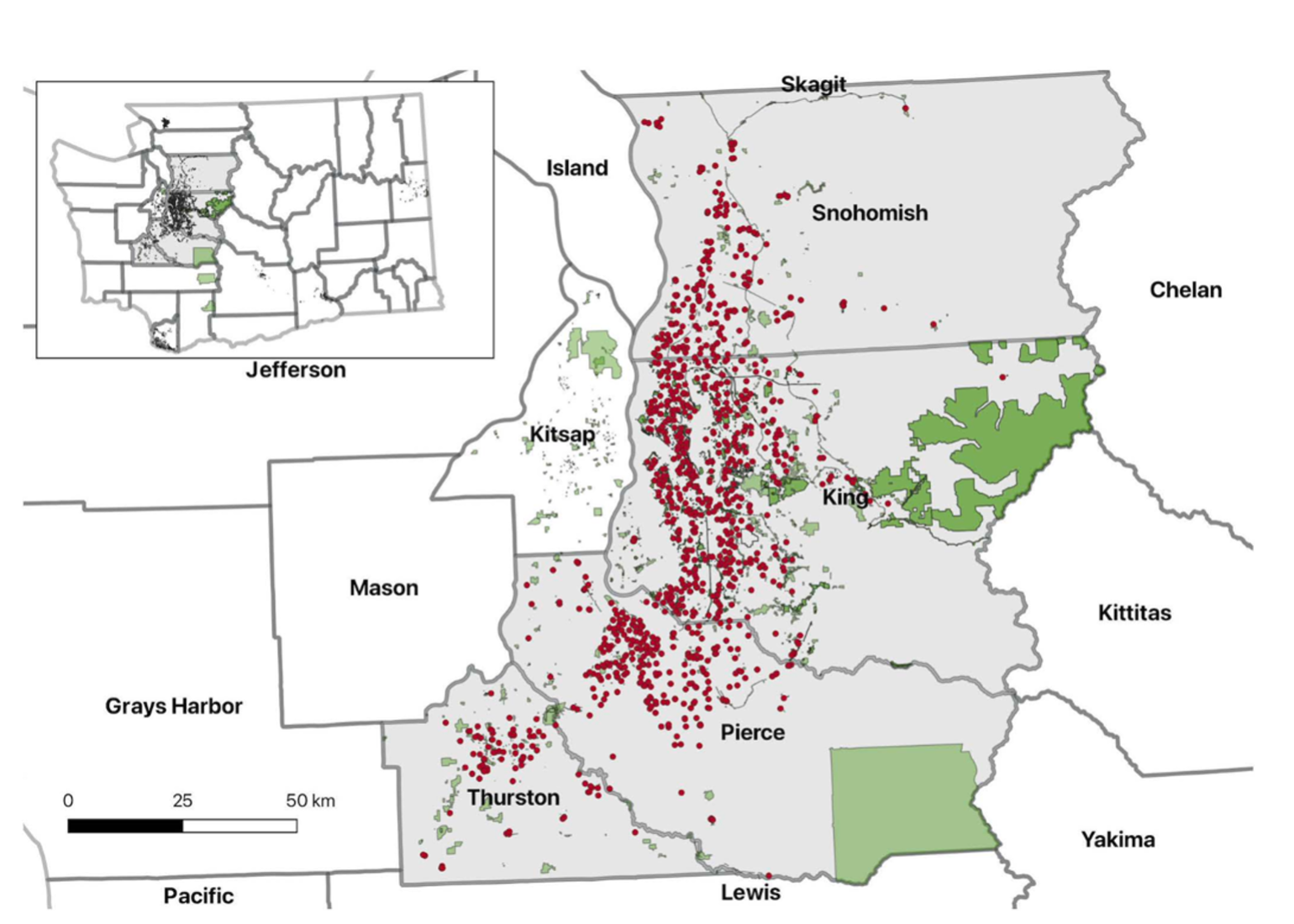
The presence of a public park(green space on the map) within half a mile of a school (red dots) was associated with an increase in standardized test performance among middle schoolers. Specifically, proximity to a park correlated with a five percent increase in the number of eighth graders who met or exceeded standards for language arts, math, and science assessments.
Although the study took place in “The Evergreen State,” the researchers did not find any association between improved academic performance and the greenness of the local park. Proximity to any public park, regardless of the level of vegetation, was associated with an increase in test scores. Additionally, there were some factors, such as household income status, that were identified as more important predictors of academic success, overruling any influence park proximity may have had on lower-income students’ performance.
The authors venture that middle schoolers were especially receptive to the benefits of nearby parks because they have more independence to explore than elementary students but fewer responsibilities than high school students. They recommend that future park placement should prioritize locations near lower-income middle schools to improve academic performance by prompting adolescents to get outside.
In this study, the authors considered the distance from a school to a park. What they didn’t consider were the numerous difficulties that could be present in getting there. A park’s location may look convenient on a map, but students could be deterred from spending time there due to busy roads, poor lighting, and unsafe surroundings. When building a new park, urban planners suggest improving visibility in parks, prioritizing accessibility, and adding consistent lighting to make parks safer.