Urban Design: The Key to Encouraging Walking
Relocating to a walkable city increases daily steps by up to 1,400, while moving to a less walkable one markedly decreases them.
Read Time: 2 minutes
Published:
- Urban design in a city or neighborhood influences the physical activity of residents.
- Living in a highly walkable city can increase activity by up to 1,400 steps per day.
After a long day, it is much easier to get cozy on the couch than to take a walk, especially when taking a walk may mean getting in your car first. We use cars to run errands, get to the gym, or even drive to the start of an afternoon stroll. But that’s not the norm everywhere; many people commute to work by walking. Our neighborhoods can tip the scales when it comes to how often we walk.
To evaluate the effect of city walkability on activity patterns, Tim Althoff and colleagues analyzed daily step counts using smartphone health app data from two million adults in the United States. They also collected data on where people lived over three years, paying attention to study participants’ relocation patterns. Participants were considered to have relocated if they moved to a location over 100 km away for more than 14 days.
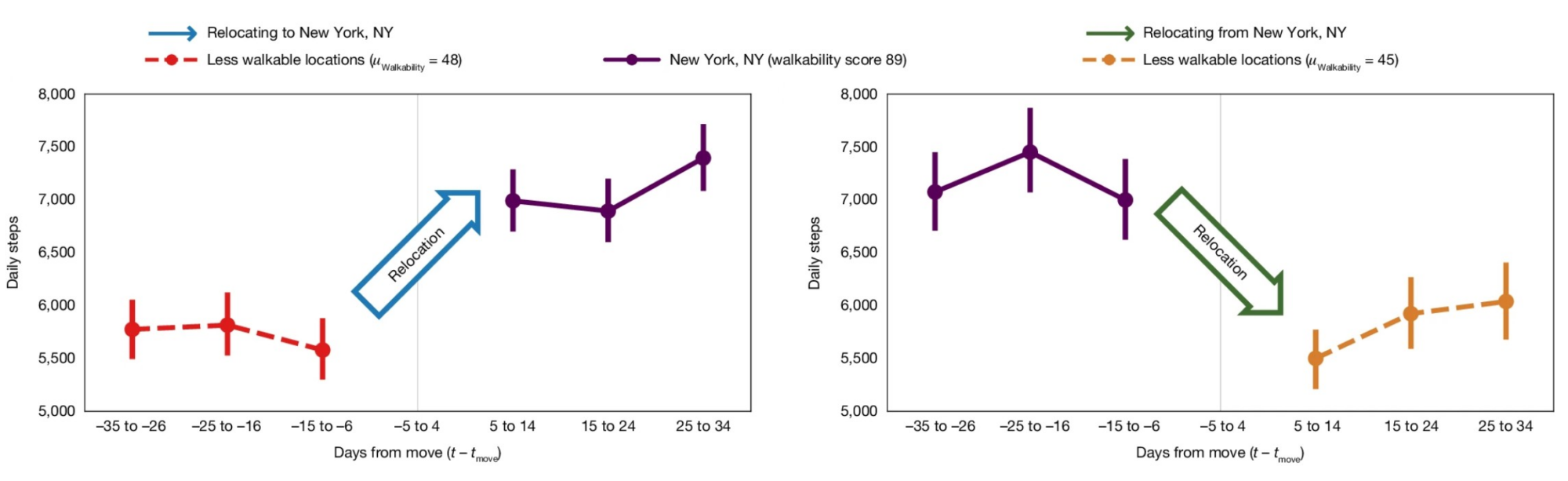
The researchers measured walk scores, ranging from 0 to 100 (higher scores indicate higher walkability), based on the presence of sidewalks, crosswalks, and public transportation. As shown in the graphs above, on average, physical activity increased by 1,400 steps (0.6 miles) per day after participants relocated to a walkable city, like New York City, which has a walkability score of 89, from a less walkable city. For participants who relocated out of a walkable city, overall physical activity decreased (in the case of New York City, average daily steps decreased by 1,400).
There are many walkable cities across the country where having a car isn’t a necessary part of daily life, such as in Boston. Beyond physical health, walkable cities offer many environmental benefits, as well. More people walking instead of driving can reduce pollution from transportation, the largest contributor of greenhouse gas emissions in the U.S.
The authors recommend designing more walkable cities to make physical activity easier and more accessible. More Americans should have the opportunity to live in areas where the choice to walk is pleasant and accessible, not an inconvenience.