Air Quality: An Unequal Burden
While overall air pollution has declined since the 1990s, Black and Hispanic communities continue to bear the brunt of toxic exposure.
Read Time: 2 minutes
Published:
- Although overall levels of air pollution have improved, Black and Hispanic communities remain most affected.
- Recent attacks on the Clean Air Act have weakened regulation of PM2.5 emissions and may worsen nationwide emissions.
Step outside and feel the breeze. An invitation, but not for everyone. Four in ten Americans are breathing air filled with pollutants like ozone and fine particulate matter (PM2.5). Even short-term exposure to polluted air can leave people vulnerable to increases in heart attacks, strokes, lung damage, and even death.
Exposure to particle pollution varies based on location, with worse air quality in industrial areas. People living in neighborhoods near factories and highways are consistently exposed to higher levels of pollution. These are often lower-income communities where Black and Hispanic populations make up the majority.
To evaluate the difference in deaths related to PM2.5 exposure by race, Pascal Geldsetzer and colleagues analyzed nationwide mortality data by county between 1990 and 2016. Using data from the U.S. Census and the National Center for Health Statistics, the researchers examined the effects of education level, rurality of the county, socioeconomic status, yearly PM2.5 estimates, and mortality data.
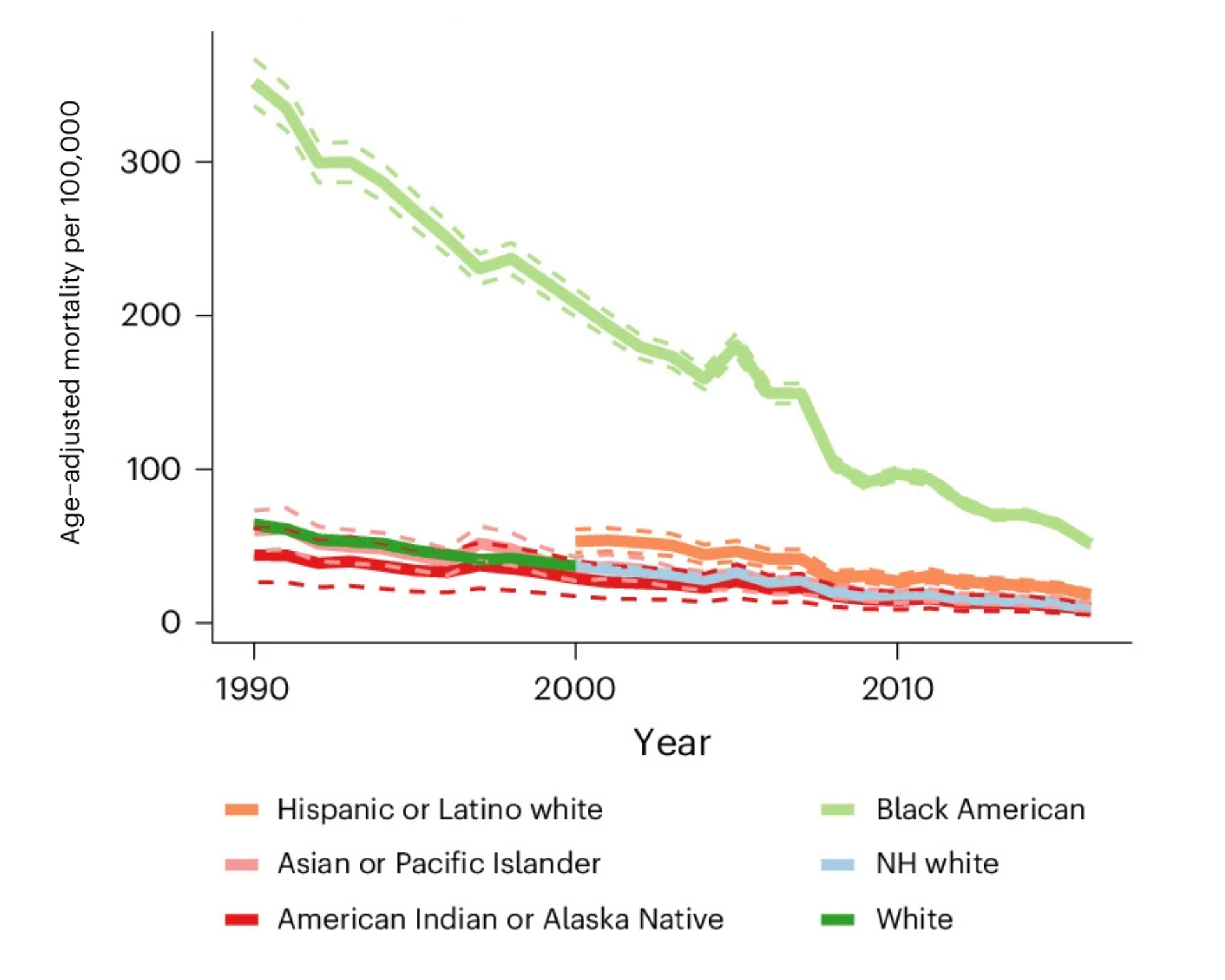
Exposure to pollution was highest among Black Americans, followed by Asian or Pacific Islander and Hispanic populations. Despite overall decreases in deaths over the study period, Black Americans remained most affected by yearly PM2.5 exposure, as shown in the graph above.
When comparing rates of death from all causes among Black and White Americans, the analysis found that more than half of the mortality difference was linked to PM2.5 exposure between 2000 and 2011. In later years, the researchers reported that this difference decreased by a small margin.
Air quality is everyone’s problem, but these findings show that not all Americans are affected equally. Although this analysis uses data up until 2016, this inequality is not a thing of the past. A 2024 study predicts that these disparities will persist until at least 2040.
Recent attacks on the Clean Air Act have weakened regulation of PM2.5 emissions and may worsen nationwide emissions. Already, the EPA has removed standards to regulate vehicle emissions, a significant step back considering that transportation accounts for 28% of the United States’ greenhouse emissions. Hispanic and Black communities remain more likely to live near hazardous sites and other sources of pollution. Implementing policies that address inequities, such as New Jersey’s Environmental Justice Law, which requires the denial of permits for facilities that will disproportionately affect already over-polluted communities, offers one model for improvement.