Becoming a Dad Too Soon May Be Bad for the Heart
Younger fathers may face unique challenges and stressors that contribute to poorer long-term heart health. (From 2024)

Read Time: 2 minutes
Published:
This piece was originally published in September 2024.
Fatherhood is a major milestone in a man’s life, bringing joy but also new responsibilities and stress. While having children can motivate healthier behaviors and improve mental health for many men, the pressures of being a dad can also negatively affect a man’s physical well-being.
John James Parker and colleagues analyzed data from the Multi-Ethnic Study of Atherosclerosis (MESA), which tracked cardiovascular health metrics and outcomes in over 2,800 men from their 40s through their 80s. The researchers calculated a cardiovascular health (CVH) score for each man based on factors like diet, physical activity, body weight, blood pressure, cholesterol, and blood sugar. A higher CVH score indicated better cardiovascular health.
Overall, fathers had slightly worse CVH scores than non-fathers (63.2 vs 64.7), as shown in the leftmost graph below. But the age at which a man first became a dad seemed to matter even more, as shown on the right. Men who had their first child before age 25 had notably lower CVH scores compared to those who became fathers after age 35. The researchers found that this association persisted even after accounting for factors like race, ethnicity, education, and income. This suggests that becoming a father early in adulthood may take a long-term toll on heart health.
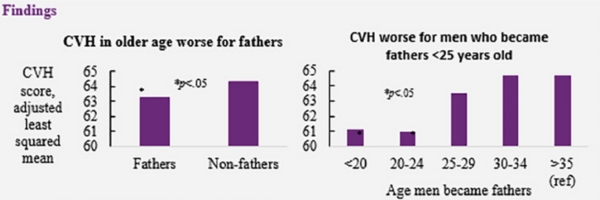
The study authors speculate that younger fathers may face unique challenges that contribute to poorer long-term heart health. These could include disrupted sleep patterns, increased stress from balancing work and family responsibilities, and less time for physical activity and maintaining a healthy diet. Older fathers, on the other hand, may be more financially stable and emotionally prepared for the demands of parenthood, allowing them to better maintain healthier habits.
Understanding the complex relationship between fatherhood, age at first becoming a father, and cardiovascular health—and developing interventions for young fathers—could have significant public health implications, as most men in the United States become fathers at some point in their lives.