Boredom? Think Motivation
Boredom does not always have to be a negative emotion. Recent research shows that it can be a key motivator for seeking new challenges.

Read Time: 2 minutes
Published:
- Feelings of boredom aren’t necessarily the problem. Our reaction to boredom determines its impact on well-being.
- Learning to reframe feelings of boredom can increase motivation for challenge and promote healthier behaviors.
We live in a world where attention is in short supply, yet people are more bored than ever. In the United States, rates of boredom have been steadily rising since 2010. We typically associate boredom with negative behaviors such as impulsivity, poor academic and work performance, and feelings of depression. Our reaction to boredom determines its impact on well-being. For instance, during the COVID-19 pandemic, boredom from isolation allowed many to discover new hobbies and interests. Learning to use boredom may be the key to reaping its benefit.
The Meaning and Attentional Components (MAC) model of boredom suggests that the feeling arises from a mismatch in the attention an activity requires and an individual’s available attention. For instance, putting a college student in an elementary school class would result in the student feeling bored. Conversely, an elementary school student in a college-level math class may also be bored because the content is too difficult to engage.
Christopher Mylnski and colleagues tested the effects of boredom on the motivation of 297 college students. Participants were divided into two groups and shown different versions of a video lecture designed to manipulate levels of boredom. Then they completed questionnaires to gauge their perceived levels of boredom, mood, and desire to engage in meaningful and challenging activities. Students in the group that watched the less engaging version of the video (bored cohort) reported worsened mood and lower energy levels than those who watched the more engaging version (control group). However, the bored cohort reported a higher desire for challenge compared to the non-bored control group.
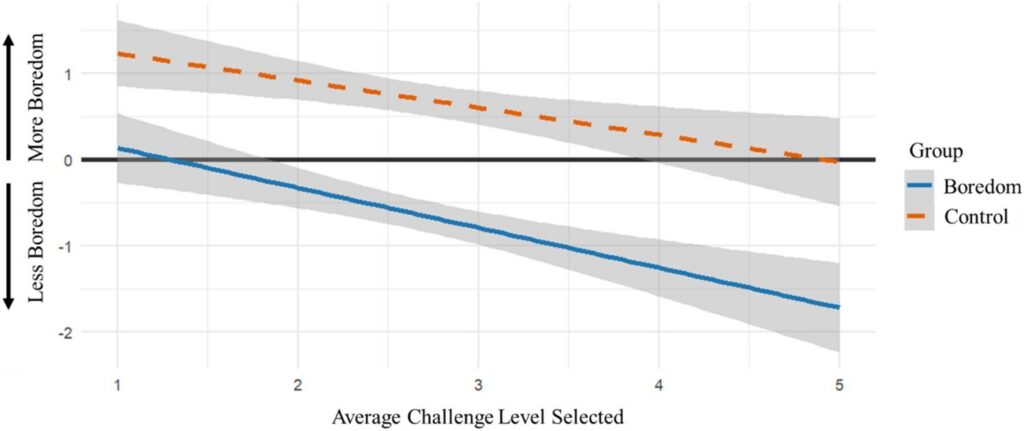
The graph shows changes in levels of boredom based on challenge level selected. Participants in the boredom group who chose a higher challenge level reported being less bored afterwards. In the control (non-boredom) group, selecting a higher challenge appeared to prevent increases in boredom.
Many of us turn to our devices when faced with even the thought of boredom. Although scrolling seems like a quick fix, research has shown that this habit does not achieve its intended effect. Mylnski and team suggest that boredom can motivate us to seek challenges, offering an opportunity to change our response to situations that do not capture our interest. From a public heath perspective, understanding and learning to reframe feelings of boredom to increase motivation for challenge can promote healthier behaviors.