Minimal Increases, Maximal Impact
Recent research shows that just a 10% increase in state minimum wage would bring over 58,000 households out of food insecurity.

Read Time: 2 minutes
Published:
- Increasing minimum wage by 10% is associated with decreases in the number of households experiencing food insecurity.
- A change in minimum wage policy would be more impactful than changes in SNAP payments or tax credits alone.
The federal minimum wage has remained at $7.25 per hour since 2009. Thirty-four states have raised their minimum wage in the years since, but many others have not. Georgia, Oklahoma, and Wyoming have set their minimum wage below the federal level. And five states — Alabama, Louisiana, Mississippi, South Carolina, and Tennessee — have no minimum wage threshold.
Even in states where the minimum threshold is higher than $7.25, workers struggle to make ends meet. A recent analysis shows that $15 per hour is not enough to cover the cost of living in any state. For working families with children, low wages mean high levels of food insecurity, defined as a lack of reliable access to food, as well as other difficulties with housing and transportation.
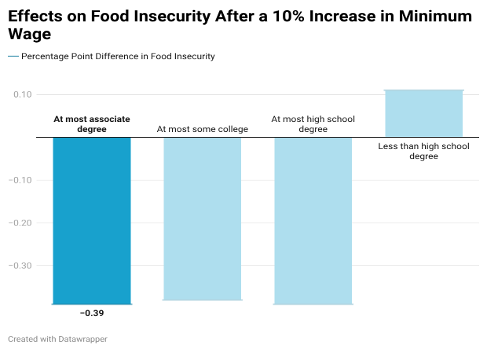
To get a better picture of how widespread food insecurity is, Megan Winkler and colleagues sampled data from an annual survey comparing changes in the minimum wage with reports of experiences of food insecurity from 2005 to 2022. Data from nearly 98,000 working households with at least one child aged 18 years or younger were included in the study. The researchers analyzed households where the highest education obtained was an associate’s degree (or two years of college), a common background for minimum wage workers.
They found that just a 10% increase in state minimum wage would bring over 58,000 households out of food insecurity. For a minimum wage of $7.25, this would be a 73-cent increase. While still not enough to cover the costs of living, following this model, a change from the federal minimum wage to $15 an hour would bring over 250,000 households out of food insecurity.
The authors suggested that an increase in minimum wage can address household needs beyond food relief programs such as SNAP. The proposed “Living Wage For All” Act, which would raise the minimum wage to $25 an hour, is just one example of a change that could have dramatic effects on nutrition nationwide.