Medicaid Renewal and the Risks of Unenrollment
Nearly 13% of Medicaid enrollees lose coverage at the annual renewal deadline, often due to procedural errors rather than ineligibility.

Read Time: 2 minutes
Published:
- Every year, many Medicaid enrollees lose coverage for reasons that are not due to ineligibility.
- More than half of people who miss a renewal deadline remain without Medicaid for at least 12 months.
In the United States, access to health insurance is not guaranteed. Even those who are low-income or disabled and receive Medicaid insurance undergo a regular and increasingly restrictive renewal process and risk coverage discontinuation. Unenrollment affects access to medical visits, prescriptions, and financial stability.
Importantly, people can lose coverage for reasons that have nothing to do with eligibility. In 2023, more than 70% of Medicaid recipients lost coverage for procedural reasons, not due to ineligibility.
For instance, someone might not have received renewal notices or responded to warnings about potential Medicaid loss because they didn’t understand them. People may also have difficulty submitting requested documentation or face processing errors.
Missing the renewal deadline often means a termination of benefits and a gap in insurance coverage. Studies have associated even temporary insurance loss with increases in unmet health care needs, hospitalization for avoidable health issues, and medical debt.
Laura Dague and Rebecca Myerson analyzed health records of 600,000 Medicaid recipients. Over a four-year period, they tracked the proportion of people who lost coverage at the 12-month renewal deadline and the time it took for them to regain coverage.
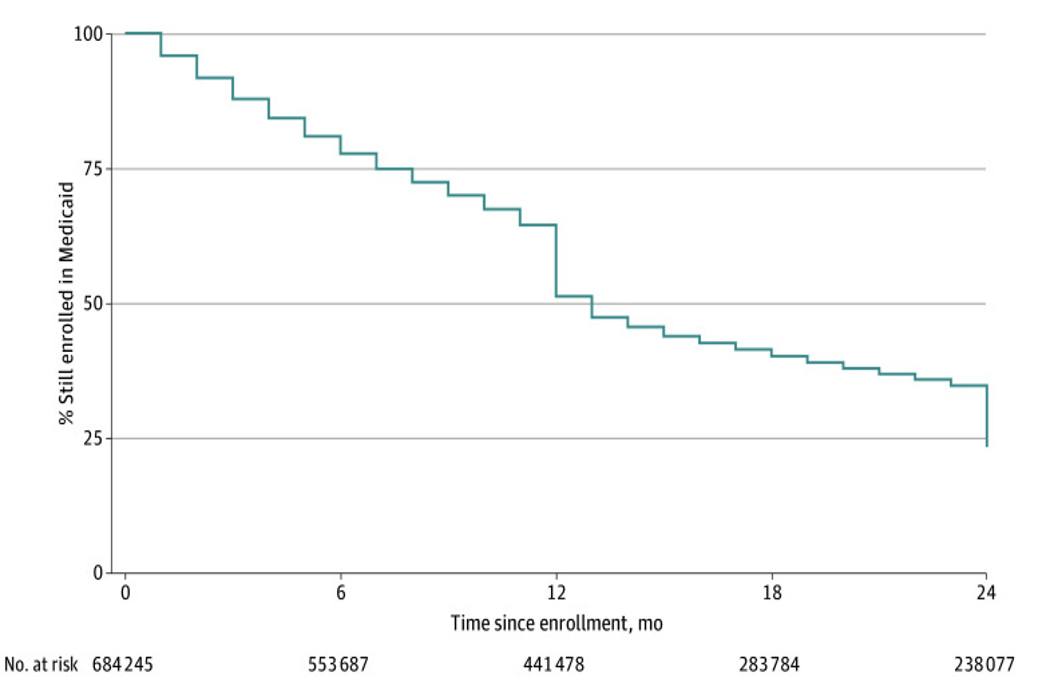
The figure above shows the percentage of people who remained enrolled in Medicaid after their 12-month renewal deadline. Thirteen percent (90,348) of enrollees lost coverage at the deadline.
More than half of those who lost coverage remained without Medicaid for at least 12 months. The downward trend in unenrollment reflects the burden of the renewal process on enrollees. Almost half of people without insurance report not seeing a doctor in the past year.
These findings highlight avoidable financial losses for the Medicaid system itself. It costs Medicaid up to $500 each time an enrollee loses and regains coverage. Recent decisions to implement more frequent Medicaid renewals (every 6 months rather than 12 months) beginning in 2027 make procedural disenrollments even more likely. Strategies to help maintain insurance coverage include automated renewals and in-person renewal assistance.