Politicized Vaccines, Avoidable Deaths
More children with Democratic parents received their first MMR dose on track with vaccine schedules than children with Republican parents.
Read Time: 2 minutes
Published:
- Children with Republican parents are less likely to receive timely MMR vaccines than children with Democratic parents.
- Growing numbers of unvaccinated children have put communities at risk for measles outbreaks.
A life sentence in an iron lung, a body covered in painful pustules, and a tragic loss of immune memory are all preventable today due to vaccines. Polio, smallpox, measles, and dozens of other infectious diseases no longer hit us like they used to, provided we are up to date with recommended immunizations. Despite their proven safety and effectiveness, many Americans delay or refuse vaccines. Vaccine hesitancy is not new; it has existed as long as vaccines. However, today’s growing political polarization of vaccine acceptance is alarming, and the WHO has identified vaccine hesitancy as one of the top ten threats to global health.
Claire M. Morton and colleagues analyzed individual voter registration records and electronic health data to assess the relationship between parental political affiliation and childhood vaccine uptake. The study included nearly 47,000 children born between 1988 and 2024 whose parents’ voting records indicated a clear party affiliation. Electronic health data from primary care practices provided information on vaccine refusals and delays among those children, particularly for the measles, mumps, and rubella (MMR) vaccine.
Findings showed that more children with Democratic parents received their first MMR dose on track with the most lenient vaccine schedules (between 12 months and 3 years and 11 months of age) than children with Republican parents. As the figure below shows, the difference in childhood vaccination timeliness in Democrat and Republican homes has been growing since 2005. Since 1988, the gap between the parties for first MMR doses has grown to roughly 2.5 months. While this may not seem immediately consequential given the wide window for on-track first MMR doses, the gap points to a growing deviation in vaccine behaviors between party-affiliated voters.
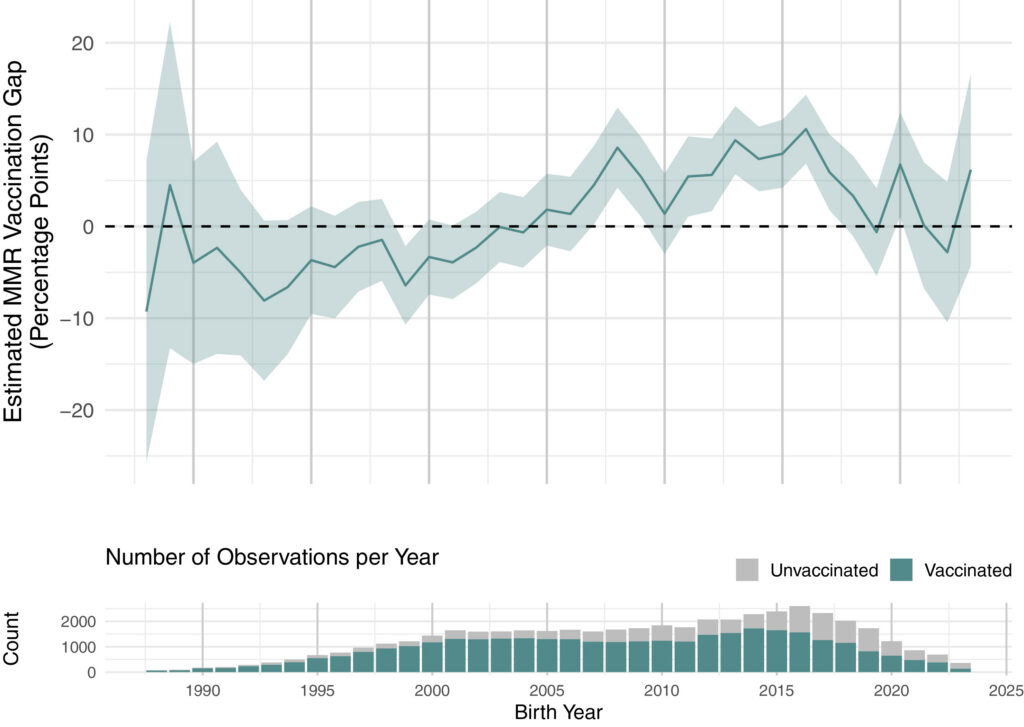
Additionally, parents who voted Republican were less likely to vaccinate their children at all compared to parents who voted Democrat. The gap in childhood vaccination rates by parental party affiliation is growing by roughly 9,000 children every year, which can substantially affect a community’s collective, or herd, immunity to infectious disease outbreaks.
The consequences of declining vaccination rates are becoming rapidly apparent, with nearly 3,000 measles cases reported in the United States as of August 2026. This study by Morton and colleagues adds individual-level detail to previous findings showing partisan gaps in public opinion on vaccines. The current findings suggest individual political affiliations may be bleeding into routine health care decisions for children and interfering with evidence-based recommendations for vaccination schedules.