Vitals from Home: The Potential of Remote Patient Monitoring
Remote patient monitoring devices allow for more convenient, cost-effective care, benefiting both patients and providers.
Read Time: 2 minutes
Published:
- Remote patient monitoring devices allow for more convenient care, benefiting both patients and providers.
- Although use of remote patient monitoring devices has increased in the U.S., wider adoption could allow the technology to benefit more patients.
In 2025, over 71 million Americans used remote patient monitoring (RPM) devices to manage their health care from home. Remote devices allow health care providers to collect patient vitals like blood pressure, blood sugar, and heart rate without the patient traveling to a physical clinic. Face-to-face interactions have long been the standard for providing patient care, but advances in technology have expanded our options.
The technology offers various benefits, including reductions in health care costs. Remote monitoring use has been associated with reduced hospital readmissions, improved adherence to medication, and stronger communication between patients and clinicians.
Medicare began reimbursing clinicians for remote patient monitoring services in 2019. Joseph H.Joo and colleagues analyzed the use of remote patient monitoring across the U.S. using Medicare payment data.
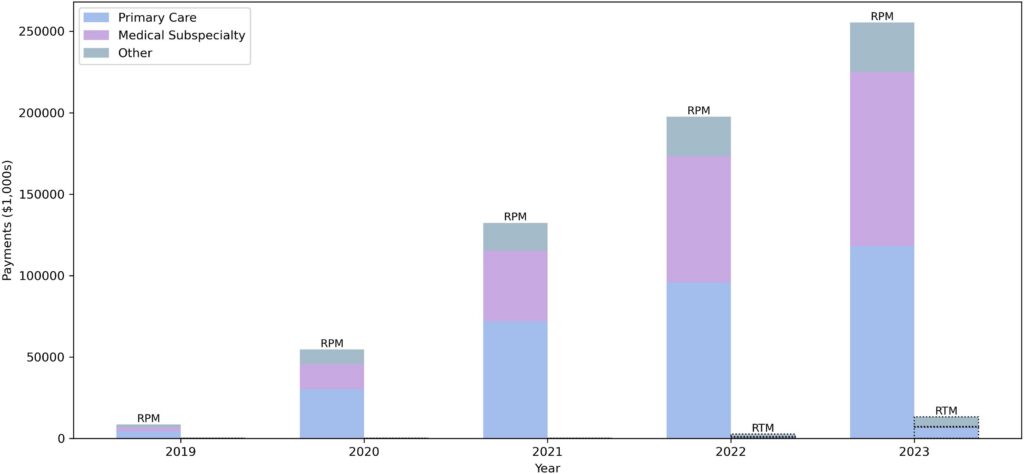
Payments were grouped based on the specialty of the doctor who used the technology. As shown in the figure above, the use of remote patient monitoring devices increased by over 3,000% between 2019 and 2023. However, the distribution of payments by physician specialty was uneven.
Primary care doctors alone accounted for nearly half of RPM use. These providers typically use remote monitoring tools to manage patients with chronic conditions (such as hypertension). Other subspecialists (such as cardiologists) made up one-third of RPM use and have had an increase in use over time. Meaningful use among other specialists suggests that the technology can be used more widely.
The authors’ findings demonstrate the opportunity for remote monitoring use to grow. They note that this study was limited by its use of Medicare data and the absence of region-specific trends. As the technology improves, future work will involve barriers to adoption and the impact of RPM devices on patient health.