Aging: An Unequal Experience
A recent study shows that for older Americans, income and financial assets largely shape the aging experience.

Read Time: 2 minutes
Published:
- Older Americans are struggling to meet higher costs of living, utilities, and health care.
- Income difficulties affect feelings about both mental and physical health among individuals 65+.
According to the United States Census, one in five adults is sixty-five or older. Most older Americans are faced with at least one chronic health condition, such as arthritis or diabetes. Yet many struggle to access health care. Barriers to receiving care include a lack of health insurance and the expense of health care services, even with insurance. In 2020, adults above the age of 65 spent over $6,000 on out-of-pocket costs.
To understand the factors affecting the aging experience, Luona Lin and Juliana Menasce Horowitz surveyed a nationally representative sample of 8,750 U.S. adults in September 2025. The researchers gauged Americans’ feelings about aging and grouped participants by income level (high, middle, and low). Lower-income families had incomes below $51,900, middle-income families had incomes from $51,900 to $155,600, and upper-income families had incomes above $155,600.
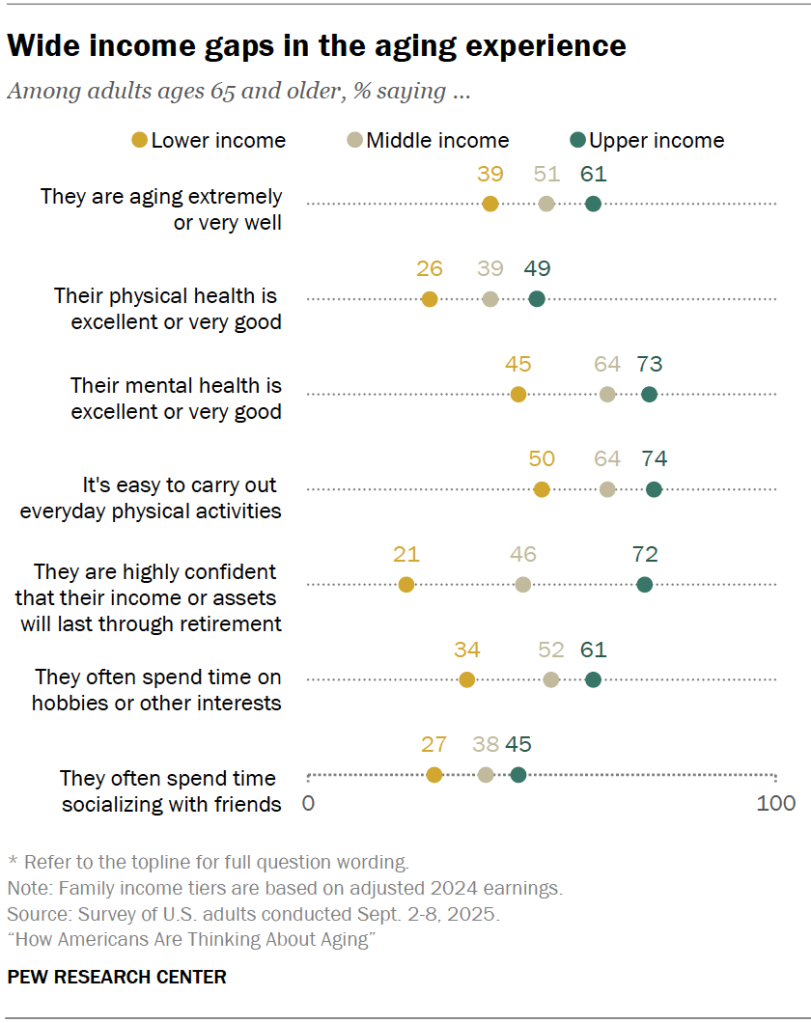
The figure shows participant responses to aspects of growing older by income level. Seventy-five percent of upper-income adults rated their mental health as excellent or very good, and half reported excellent or very good physical health. For lower-income adults, these proportions dropped to less than half. Older adults in the higher-income group were also more likely to report spending time pursuing hobbies or socializing with friends, compared to lower-income adults.
These findings align with trends that show many older Americans are struggling to meet higher costs of living, utilities, transportation, and health care. The authors highlight financial concerns as a primary stressor associated with aging. Although Social Security remains one of the primary sources of income for individuals over age 65, it is often inadequate to keep up with rising costs of living.
Strategies to address income disparities should begin earlier in life, as financial inequalities only widen with time. Research has tied poverty rates experienced at an early age to poverty in later stages of life. Policies that increase the federal minimum wage, widen Medicare coverage, and reduce health care prices are ways to reduce the stress of aging with fewer assets.