SNAP for Better Heart Health
States with low barriers to SNAP participation saw fewer heart disease-related deaths than states with more eligibility restrictions.

Read Time: 3 minutes
Published:
- Increasing access to SNAP may help reduce population-level cardiovascular mortality.
- States can reform their SNAP policies for better coverage, even though federal funding is at risk.
A sparse pantry or skipped meal can mean more than just hunger for families in the United States. Food insecurity is linked to psychological stress, increased risk of chronic diseases, and poor medication adherence. The U.S. Supplemental Nutrition Assistance Program (SNAP) helps people who cannot afford today’s exorbitant food costs meet their most basic needs. Although the program is primarily funded by the federal government, states set eligibility criteria and control participation levels.
Sriya Potluri and colleagues examined how state policy variations affected cardiovascular mortality from 2006 to 2019. The team indexed SNAP policies, such as average recertification timelines, asset reporting requirements, and online application availability in each state. State SNAP policies were graded from low to high generosity based on eligibility restrictions. Using data from the National Center for Health Statistics, the authors calculated county-level cardiovascular mortality rates for adults aged 20 years and older, and then analyzed how death rates changed across states with different SNAP policies.
Residents of states with low barriers to SNAP participation (i.e., high-generosity) were less likely to die from cardiovascular disease than those in states with many restrictions. High-generosity states saw roughly 46,000 fewer cardiovascular deaths in 2019 than low-generosity states.
The team also estimated death rates if all states had adopted the same policies over the study period. As the figure shows, an average of 15,000 lives could have been saved every year between 2009 and 2016 if all states had enabled better access to SNAP (blue line) than was observed (grey line).
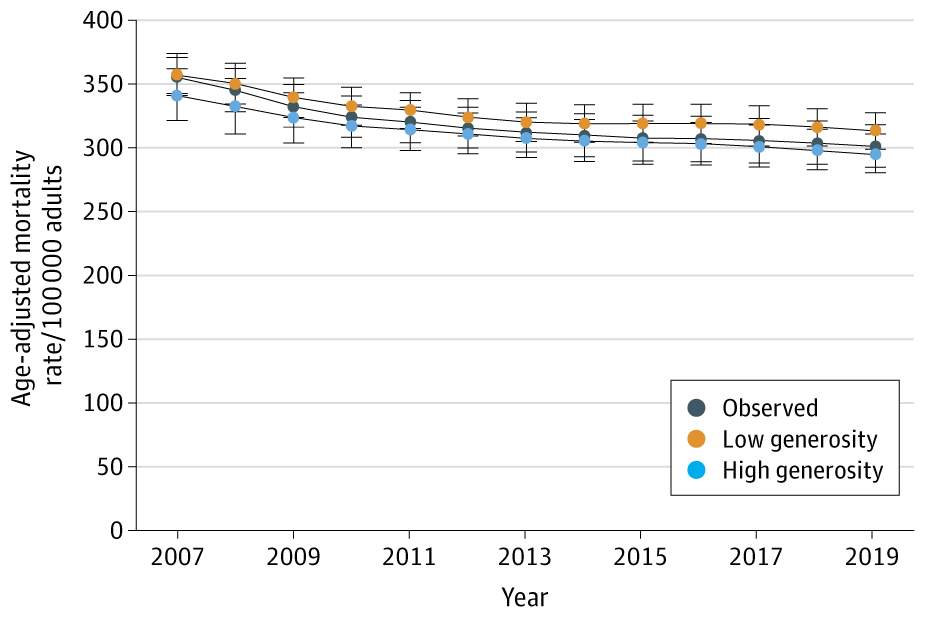
Additional analysis showed that broad-based categorical eligibility had the greatest effect on county-level variations in cardiovascular death. That is, states that adopt a policy allowing families who qualify for other assistance programs, such as the Temporary Assistance for Needy Families program, to be automatically eligible for SNAP had the best cardiovascular outcomes. Broad-based categorical eligibility policies reduce the administrative burden for families needing help, saving them time and energy and allowing them to more easily receive food assistance.
Today, SNAP is at risk as the U.S. federal government doggedly shrinks its scope and holds its funding hostage to political sparring, thereby complicating Americans’ access to affordable food. Potluri and colleagues urge states to wield their legal control over SNAP by reforming eligibility criteria and administrative practices. SNAP’s purpose is to provide stable and quality nutrition to Americans. Reforming state policies to align with that mission will help ensure everyone who needs food support receives it.