Breathing Easy In Better Homes
Boston neighborhoods that are primarily Black or Hispanic had up to 172% more reports of in-home asthma triggers than White neighborhoods.

Read Time: 2 minutes
Published:
- In-home asthma triggers disproportionately affect Black, Hispanic, and Latino residents in Boston.
- Housing code reform and building improvements may reduce asthma disparities.
Approximately 1 in every 12 people in the U.S. has asthma, making it one of the most common chronic diseases in the country. Several environmental and genetic factors can induce asthma attacks. The resulting shortness of breath and wheezing can quickly become life-threatening and require emergency care. Asthma can also cause cumulative lung damage as each attack harms the body’s airways and changes their structure. People living with asthma can prevent attacks or reduce their severity by avoiding common asthma triggers, such as dust mites, mold, and pollen.
Zichuan Li and colleagues conducted a study to better understand the effects of housing on asthma-related disparities across Boston. In-home asthma triggers were measured by tenant requests for code enforcement home inspections around pest infestations, household mold, and poor ventilation. The team also collected data on adult asthma-related emergency department visits to the Massachusetts General Brigham hospitals.
Tenant reports of in-home asthma triggers (map on the left) coincided with asthma-related emergency department visits (map on the right) in the same residential areas. Regions with more tenant reports had higher rates of emergency department visits, and vice versa.
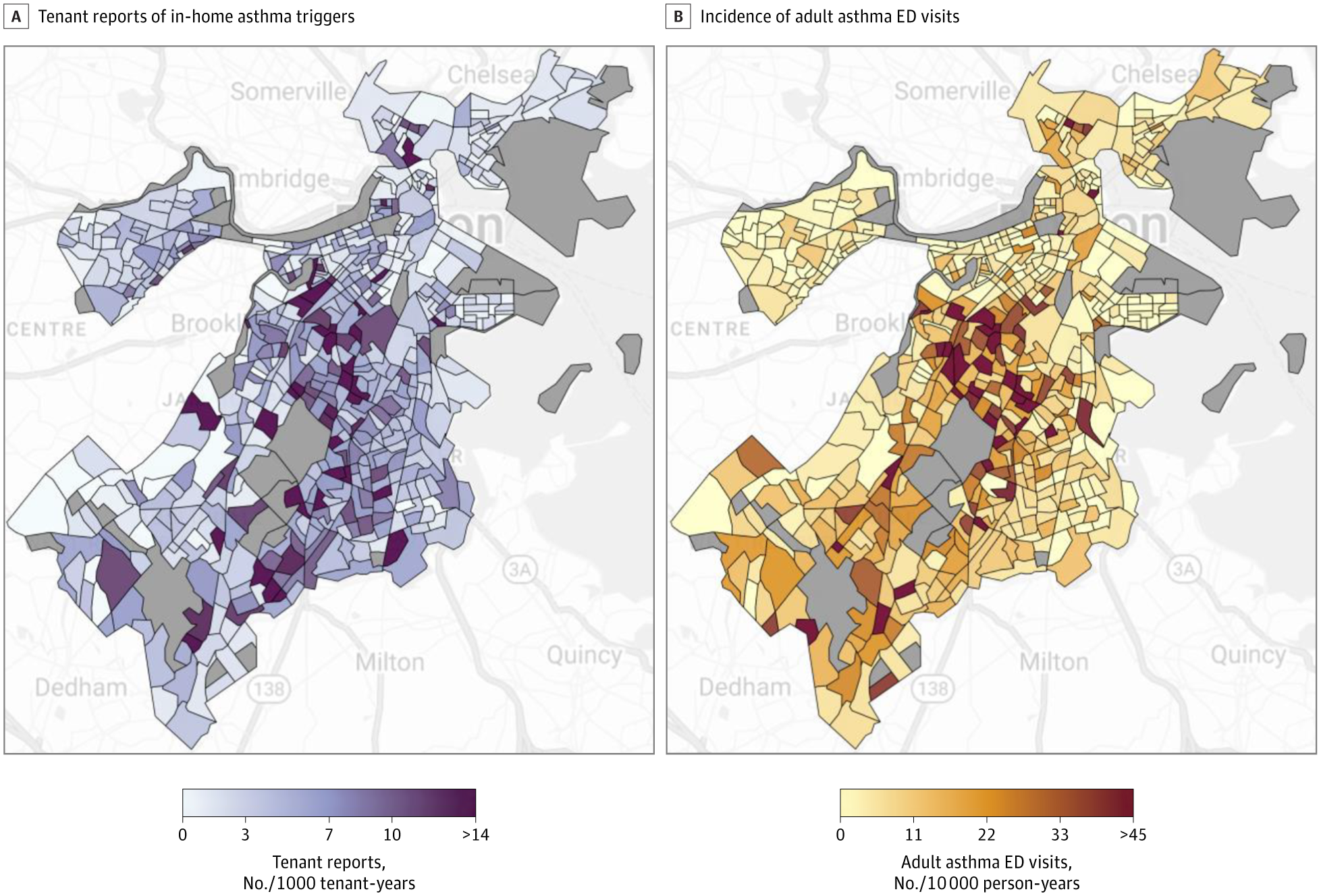
Boston neighborhoods with the most Black or Hispanic and Latino tenants had up to 172% more reports of in-home asthma triggers, compared to primarily White neighborhoods. The tendency for these neighborhoods to also experience higher asthma-related emergency department visits suggests a substantial racial disparity in asthma outcomes across Boston. This finding is consistent with previous research that shows Black people disproportionately live in heavily polluted areas and are thus more likely to be diagnosed with asthma than people of other races.
The authors recommend improving public and private housing quality to reduce the asthma burden at the population level. Evidence-based home and building improvements, such as increasing ventilation, removing water damage, and creating smoke-free multi-family buildings, can reduce dust mites, mold, and pollution, and ameliorate overall living conditions. City-level housing code enforcement reform and incentivizing landlords to keep properties up to code may further lessen racial disparities in asthma outcomes across Boston.