Down the Misinformation Rabbit Hole
Older adults are more likely to be exposed to health misinformation online, often following one misleading claim after another.

Read Time: 2 minutes
Published:
- Adults 60 years and older were more likely to be exposed to health-centered misinformation than younger people.
- Older adults have greater difficulty in determining if a headline is true or false.
- Consumption of political misinformation leads to the consumption of misinformation about other topics, including health.
“Don’t believe everything you see on the internet.” Millennials and Gen Zers have heard this from parents, teachers, and other trusted adults all their lives. However, these very same sage adults need to listen to their own advice. Adults age 60 and older are most likely to believe misinformation, including untrue or misleading claims about health.
Benjamin Lyons and colleagues analyzed survey data and online search histories from over 1,000 participants to measure exposure to misleading online health information.
They found that exposure to misinformation grows with age. Survey respondents over age 60 were substantially more likely to be exposed to misleading health websites than younger participants. Older adults also had the most trouble the rating the accuracy of headlines and claims about the causes of cancer, as shown in the graph below. Those who leaned into conspiracy theories were also more likely to end up on untrustworthy websites.
The researchers found that only a small amount of traffic to misinforming websites could be attributed to searches or social media links. Instead, the majority of these adults ended up on these sites by following one untrustworthy link after another, a pattern the paper referred to as a “rabbit-hole dynamic.”
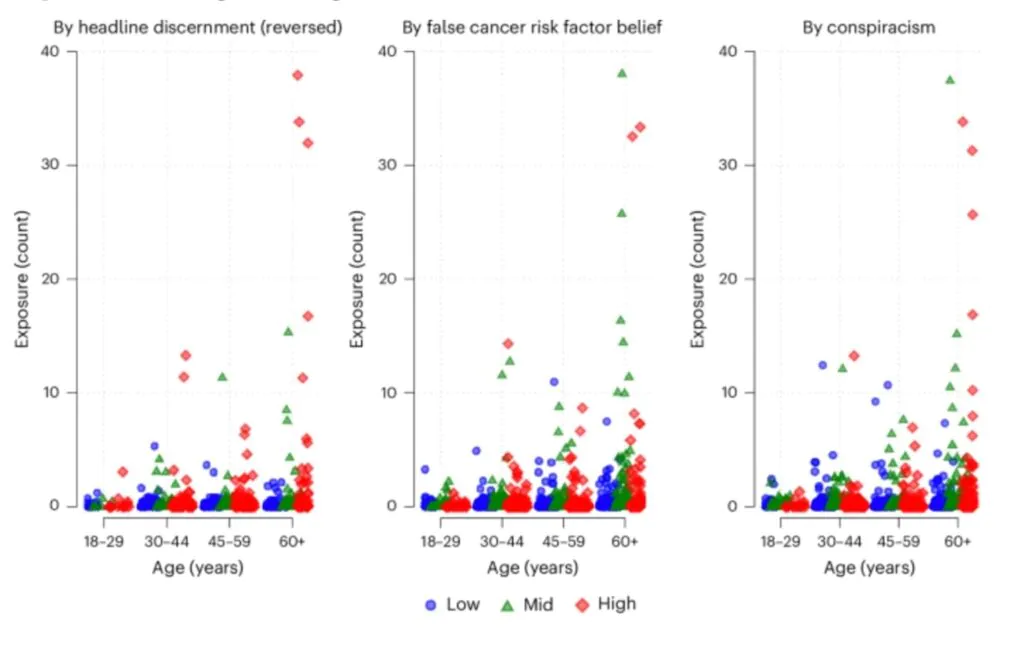
The study also found that being exposed to misinformation about one subject opened the door to other areas of falsehoods. For example, older adults who were exposed to false political news were more likely to then be exposed to health misinformation. This was especially true for older adults who held conservative beliefs, as the paper noted that, in general, most misinformation online originates from right-leaning websites. The study cited Meta’s fact-checking team, which, in 2020, determined that most misinformation exists “within a homogenously conservative corner.”
Although the partisan split in the origin of misinformation tilts right, the authors recognize that this poses a problem for all older adults trying to learn health facts. They recommend new interventions consider the entire media environment to address misinformation that targets this vulnerable group.