Missing the Mark: The Ineffectiveness of Homeless Encampment Closures
Oakland’s encampment closures surged after the 2024 ruling in City of Grants Pass v. Johnson, displacing people without reducing homelessness.
Read Time: 2 minutes
Published:
- Encampment closures do not appear to reduce the number of people experiencing homelessness.
- Homelessness alleviation efforts should focus on improving shelter and housing availability.
In 2024, the United States Supreme Court’s ruling in the City of Grants Pass v. Johnson case allowed local governments to close homeless encampments even when no shelter beds or spaces are available. The Court’s decision made way for new anti-homeless legislation across the country, with over 350 cities and 14 states passing laws that fine, imprison, or otherwise threaten homeless people who are found sleeping or living outdoors.
Prabhleen Kaur and colleagues examined how the City of Oakland’s encampment management activities changed after June 2024. They used publicly available data to map Oakland’s encampment closure activity prior to the Court’s decision and compared it with the six months that followed. Government-led closures forcibly removed people experiencing homelessness from established outdoor sleeping spaces. As closures continued, the team also monitored the shifting range of encampments across Oakland as people searched for new places to camp.
After June 2024, the overall homeless encampment closure rate in Oakland rose sharply, from an average of roughly 14 closures per month to over 32. Many displaced people had nowhere else to go. Despite fears of legal retribution, they frequently returned to known sites and re-established makeshift shelters, leading to an uptick in repeated closures. Other people moved to new camps, often scattered from the city center and away from hospitals and other city resources.
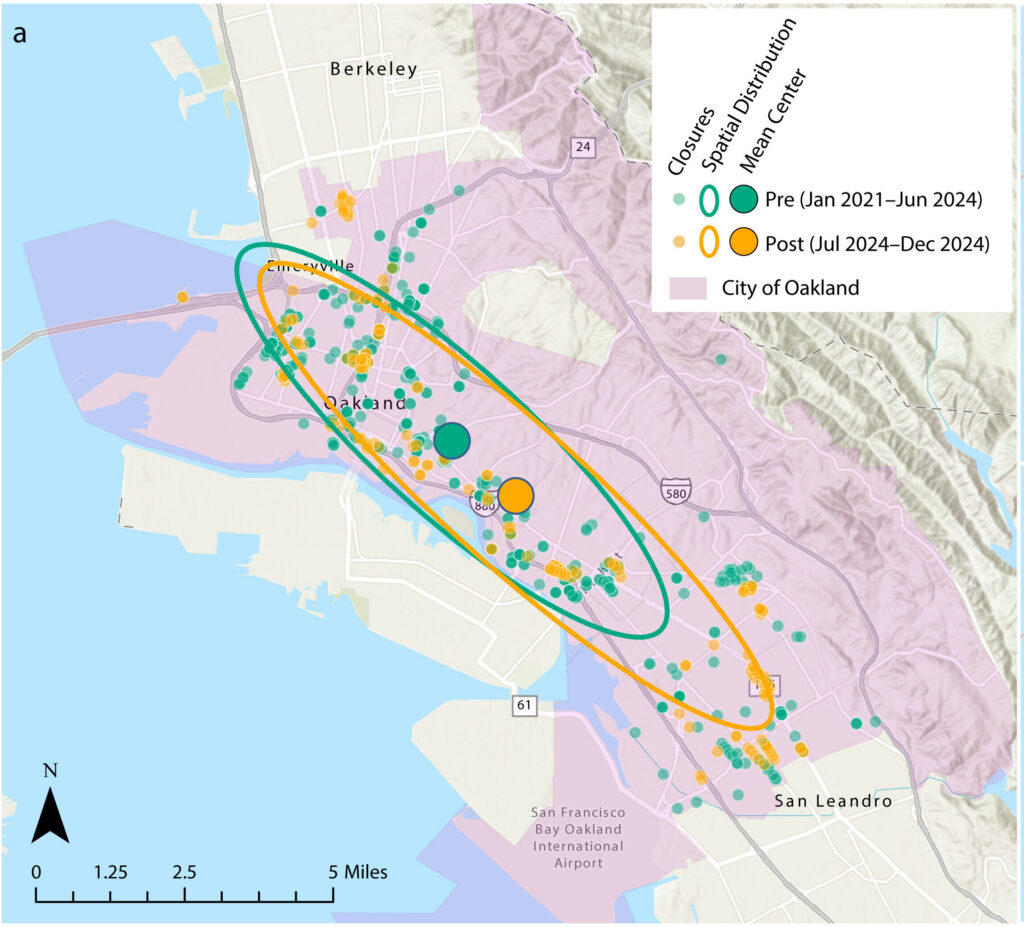
As the map below shows, there was a geographic expansion in closure activity (yellow ellipse) after the Supreme Court’s ruling. Policing reached neighborhoods that had previously been safer for people experiencing homelessness. Compared to closures before June 2024, new closures were also concentrated in lower-income neighborhoods and communities with more Black and Hispanic residents.
Taken together, these findings suggest that the City of Oakland’s enforcement of anti-sleeping bans was not an effective strategy for reducing homelessness. The authors call on state and local governments to direct future resources towards long-term solutions, such as building integrated and affordable housing and expanding outreach programs to better serve people experiencing homelessness.