Abbreviations: Time Saved, But At a Cost
Navigating health care abbreviations may come second nature to clinicians, but it often leaves patients behind.

Read Time: 2 minutes
Published:
- Abbreviations in medical documentation confuse most patients.
- Four of the five abbreviations studied (NPO, CBC, PRN, PCP) were understood correctly by less than 20% of participants.
Abbreviations may be great for texting, but not so good when providing patient care. In a field where efficiency is highly valued, condensing words is one way to save time. But when medical providers try to shorten patient notes, the time gained can leave patients lost when trying to follow the instructions given.
For many of us, the results of our blood work look like they’re written in another language. Studies have shown that patients who were confused reading their electronic health records felt less control over their health and were more likely to worry.
Most abbreviations in health care have multiple meanings. The same letters can mean something different depending on their context. For example, CP can stand for chest pain, cerebral palsy, or care plan. Differentiating between these three options may come second nature to clinicians, but leaves many patients lost.
To gauge the average person’s understanding of medical abbreviations, Corinne Praska and colleagues surveyed 200 adults who spoke English and had never been trained in the medical field. They tested the following abbreviations: ED (emergency department), PCP (primary care provider), CBC (complete blood count), PRN (as needed), and NPO (nothing by mouth).
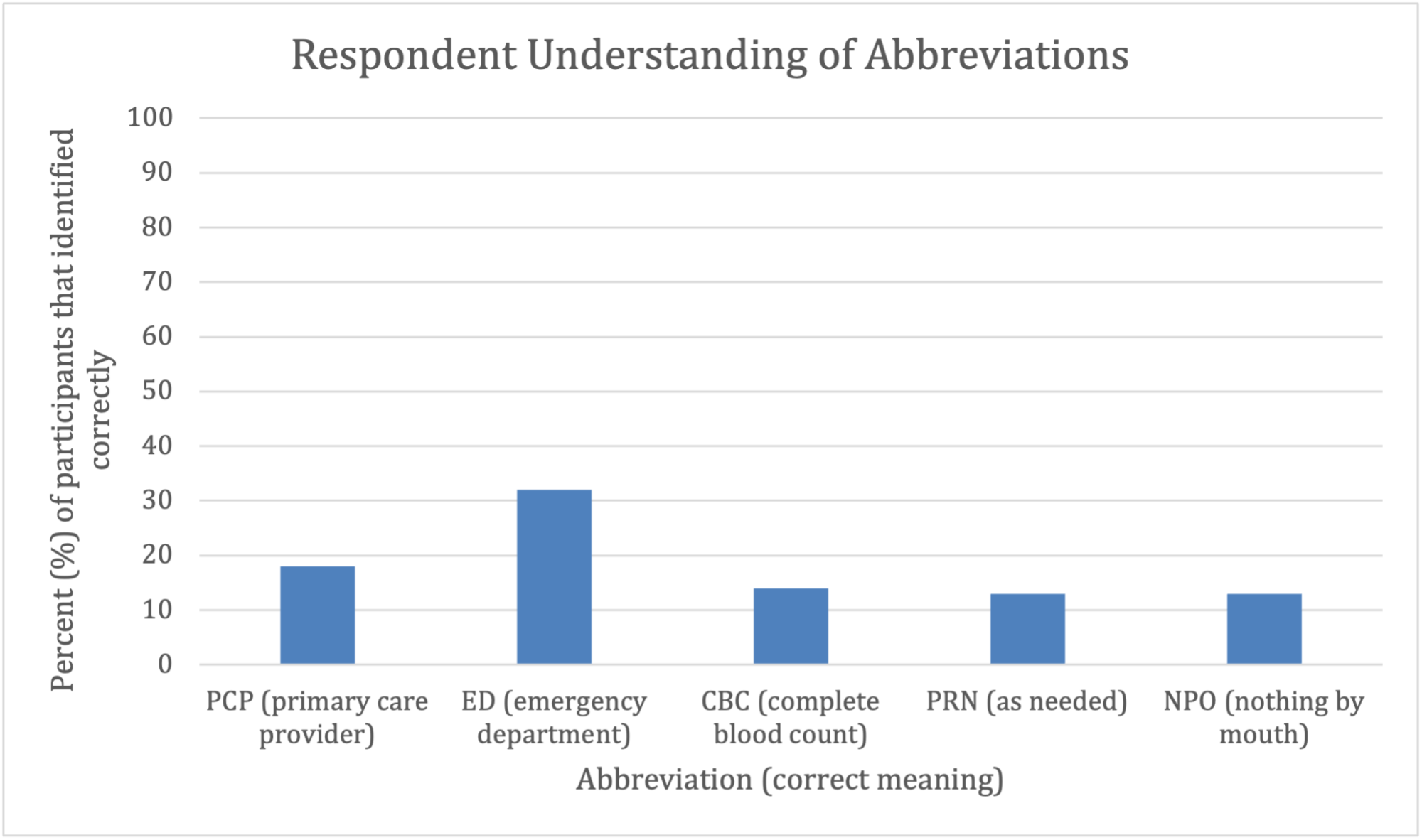
Participants completed questionnaires that asked them what they thought each abbreviation meant. Two-thirds of participants were unable to identify even the most commonly used abbreviation (ED for emergency department). And many participants identified PCP (primary care provider) as an illicit drug. Abbreviations with Latin roots, such as PRN (pro re nata) and NPO (nil per os), were understood by only 13% of participants.
Participants in this survey were, on average, more educated than the general U.S. population and all spoke English. Still, most participants were unable to correctly identify abbreviations, suggesting that levels of understanding of these abbreviations among the general population are lower than this study estimates.
In a separate survey where “you are to have nothing by mouth” was used rather than NPO (nothing by mouth), 75% of participants understood the phrase, a far greater percentage than those who understood NPO. The researchers recommend that medical professionals acknowledge their use of abbreviations with patients and families and try to always spell out words rather than abbreviate when possible.