How Faulty Faucets Harm Fetal Health
Even trace amounts of arsenic present in drinking water can have measurable and unequal effects on infant health.

Read Time: 2 minutes
Published:
Expectant mothers closely monitor what they eat during pregnancy, yet few may stop to question the water they drink. Across the United States, public drinking water contains trace amounts of inorganic arsenic, a naturally occurring but highly toxic metal. Drinking water is the primary source of arsenic exposure, which can cause long-term health damage and even impair fetal development.
The U.S. Environmental Protection Agency (EPA) enforces a maximum contaminant level of 10 parts per billion (ppb) for arsenic, which is equivalent to roughly a few drops in an Olympic-sized swimming pool. But there is no safe level of arsenic, and the agency’s long-term goal remains zero contamination.
To better understand how arsenic impacts fetal health, Anne E. Nigra and associates analyzed 13,998 mother-infant pairs across 35 U.S. pregnancy centers between 2005 and 2020. The researchers used public water system data and geocoded addresses to estimate monthly prenatal arsenic exposure and evaluate birth outcomes, shown in the graphs below.
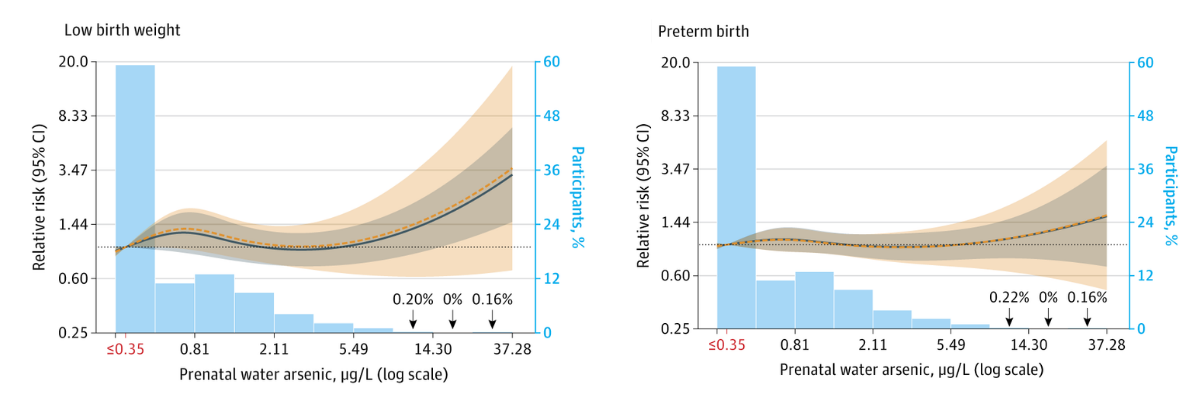
Even well below the federal limit, prenatal arsenic exposure was linked to worse outcomes like low birth weight and preterm birth. On average, infants with high arsenic exposure were born nearly 50 grams lighter than those with low exposure. Notably, arsenic was unevenly distributed across the country. Regions with more arsenic are often reliant on groundwater and small water systems that are harder to treat for contaminants.
Arsenic was most concentrated in rural parts of the Southwest, Midwest, and New England. Disparities also arose by race and ethnicity: 28% of infants with low birth weight were Hispanic, and 23% were Black. The findings show how even trace amounts of arsenic have measurable and unequal effects on infant health.
The authors recommend expanding water testing and filtration services into highly exposed communities and call for improved water standards. Although the EPA standard has not changed since 2001, a few states, including New Jersey and New Hampshire, have enforced a 5 ppb limit to reduce exposure locally. Similarly, the Netherlands enforces a strict 1 ppb limit for maximum protection. Implementing stronger water standards nationwide can meaningfully reduce preventable pregnancy complications and improve the well-being of babies nationwide.