Changing Climate, Changing Coccidioides
Climate warming and low precipitation in the coming decades could widen Coccidioides’ home range, exposing millions to the infectious fungus.

Read Time: 3 minutes
Published:
Valley fever is a lung infection caused by breathing in the spores of Coccidioides fungi. The soil-borne fungus causes cough and fever in over 200,000 adults every year in the United States. Although most infections are mild and resolve on their own, roughly 5-10% of infected people develop severe, long-term lung problems. In rare cases, Valley Fever patients can develop meningitis and even die if not treated.
Coccidioides is primarily found in the southwestern United States, but experts are concerned that our changing climate could expand the geographic range for the fungus to thrive and reproduce, putting more Americans at risk for infection. Aniruddha Deshpande and colleagues analyzed disease and environmental data to predict the potential geographic range for Coccidioides under varying levels of climate warming and precipitation change.
As shown in the figure below, the research team used Valley Fever case counts reported by physicians (county model, orange) and by emergency departments (ZCTA model, green) to create two models showing the current fungal range. They then applied climate change data from the Coupled Model Intercomparison Project to explore how the Coccidioides distribution could vary into the year 2100.
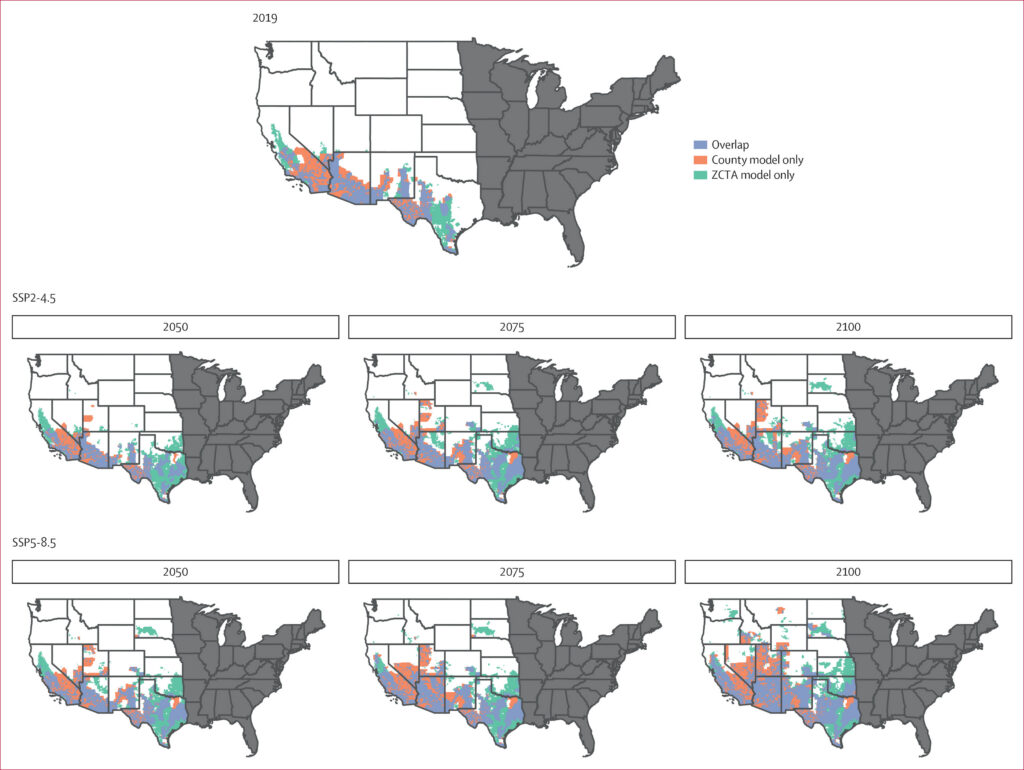
As the figure shows, parts of California, Arizona, New Mexico, Texas, and Nevada were home to Coccidioides as of 2019. The models predicted changes to this range under various climate change scenarios. If greenhouse gas emissions tripled by 2075 (SSP5-8.5), the resultant severe climate warming and lower precipitation levels would rapidly expand Coccidioides’ range (lowest panel in figure). This extreme scenario could potentially expose 38 million additional Americans to the fungus.
Even in an optimistic future with reductions in greenhouse gas emissions (SSP2-4.5), models still showed a substantial eastward and northward expansion of the fungal range. Climate warming and low precipitation levels in the coming decades, at any severity level, could widen Coccidioides’ home base. The growing fungal range could be further moderated by soil composition and land-use changes that the authors excluded from their predictions.
Currently, 26 U.S. states require all cases of Valley Fever to be reported to departments of health. However, these requirements are not uniform across the country. For example, Texas, despite being a known home to Coccidioides, does not conduct surveillance for Valley Fever and demonstrates low clinical and public awareness of the disease. These lapses in surveillance efforts could allow emerging clusters of disease to go unnoticed and burgeon into larger outbreaks, especially as climate change worsens. The authors urge the states identified in their models to bolster prevention and awareness practices to avoid being caught unprepared for higher case counts in the coming years.