Telehealth Bridges the Post-Dobbs Divide
Travel has long been a barrier to abortion access, and the Dobbs decision has worsened these disparities. Telehealth is filling the gap.

Read Time: 3 minutes
Published:
In 2022, the Supreme Court’s Dobbs v. Jackson Women’s Health decision reshaped abortion access across the United States. In the months that followed, 13 states banned abortion entirely, closing clinics, turning vast swaths of the country into an “abortion desert,” and cutting residents off from in-person care.
One way to avoid crossing the abortion desert is with telehealth medication abortion. Patients consult with a clinician online and receive abortion pills by mail. This service is available nationwide, even in states where abortion is banned. (Telehealth abortion organizations partner with doctors in states that protect clinicians who prescribe abortion medications across state lines.) This model benefits people in states with abortion restrictions and those who live far from the nearest abortion clinic.
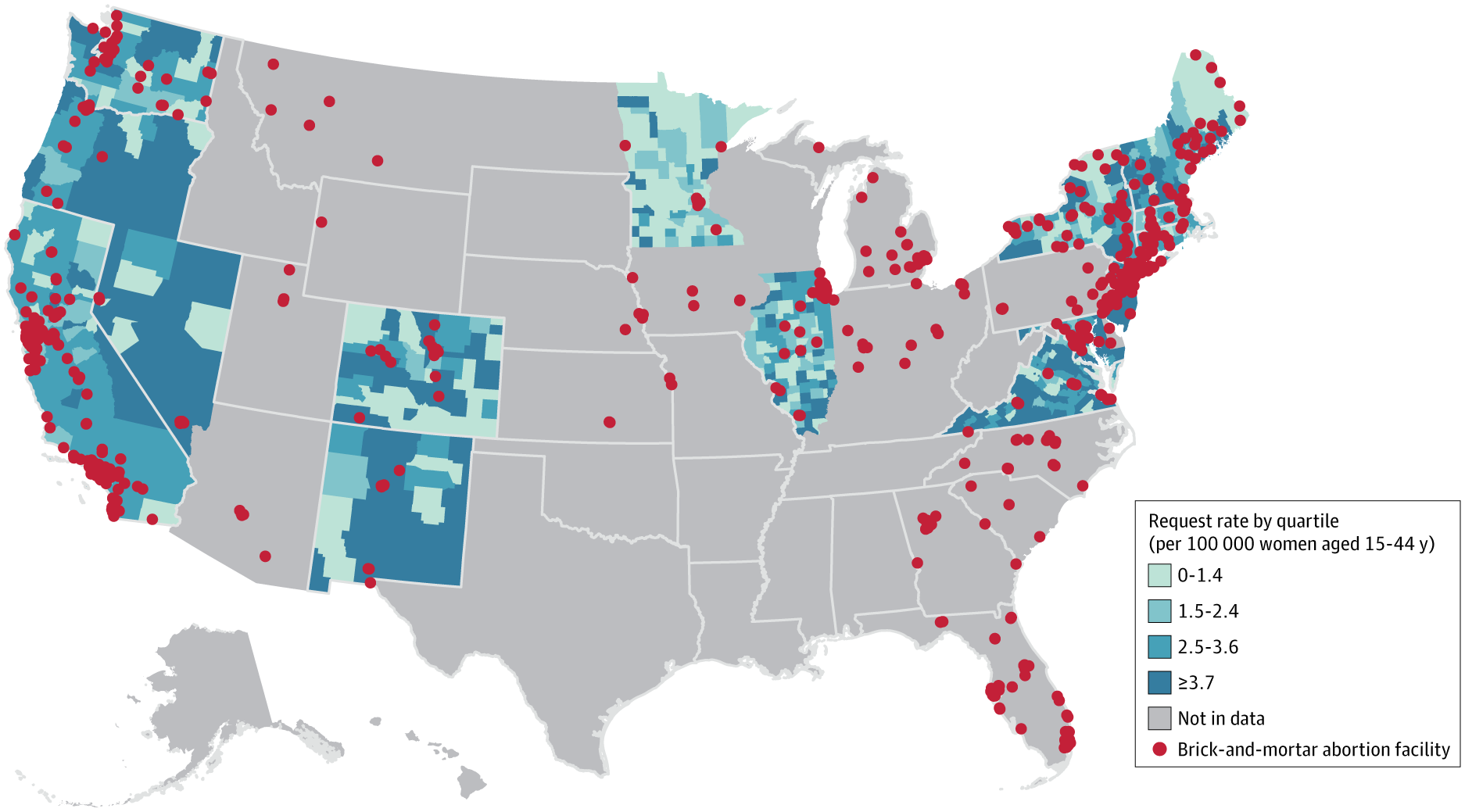
To understand how geography has shaped demand for telehealth medication abortion since Dobbs, Amy Willerford and colleagues analyzed data from Aid Access, an organization that has provided online, medication abortion care for 20 years. The researchers used data from the 18 states where abortion was legal 8 months before and after the Supreme Court decision. For each county, they counted monthly telehealth abortion requests and calculated the average distance to the nearest abortion facility.
After Dobbs, Aid Access received more than twice as many telehealth medication abortion requests—11,600 in the 8 months after the decision, compared with 4,500 before. Monthly requests jumped from 2.4 to 4.5 per 100,000 women of reproductive age. Most requests were filed at less than 6 weeks of pregnancy. Early access may indicate these patients face fewer barriers to care.
As seen on the map, requests were more common in counties farther from clinics. Each additional 100 miles of distance led to a 10% increase in per-capita requests, both before and after the decision. Even in states where abortion remains legal, uneven clinic distribution determines who can access in-person care.
Travel has been a barrier to abortion since before Dobbs, but the decision exacerbated the disparity, increasing both the number of people seeking care out of state and the distance they must travel to do so. Patients who travel farther experience delays, higher costs, and poor mental health. Some consider self-induced abortion or forgo care entirely.
Telehealth medication abortion increasingly functions as a core part of the abortion health care delivery system, not just an emergency backup. It could improve disparities in access caused by long travel distances, whether that is due to abortion bans or not, allowing people to obtain care earlier in pregnancy. As state policies shift and the availability of care fluctuates, telehealth will play an increasingly important role in abortion access nationwide.