Taking Steps Toward Better Mental Health
Increasing daily physical activity for adolescents is beneficial, with higher step counts being associated with fewer behavioral problems.

Read Time: 3 minutes
Published:
- Increased step count in adolescence is linked to fewer mental health issues.
- Higher step counts also positively impact the brain’s physical structure.
Ten-thousand steps per day. Phrases like “getting my steps in” and “closing my rings” on smart fitness devices have become commonplace as wellness culture fixates on this seemingly magical number. Though you don’t need to achieve this precise number daily, staying mobile throughout the day is often one of the first habits adults adopt to maintain a healthy lifestyle. New research poses the question: do step counts matter for adolescents as well?
Qingyang Li and colleagues examined data from over five thousand 11- to 12-year-olds taking part in the ongoing Adolescent Brain Cognitive Development study, the largest long-term study of child brain development in the country. The study aims to learn how childhood experiences interact with biology to shape how the brain grows.
Participating kids were asked to wear Fitbits on their wrists to measure how many steps they took in a day over the course of three weeks to get a sense of their average physical activity. The study followed up with the adolescents a few years later to assess their mental health. To measure mental health, the researchers monitored behavioral problems over a three-year follow-up period.
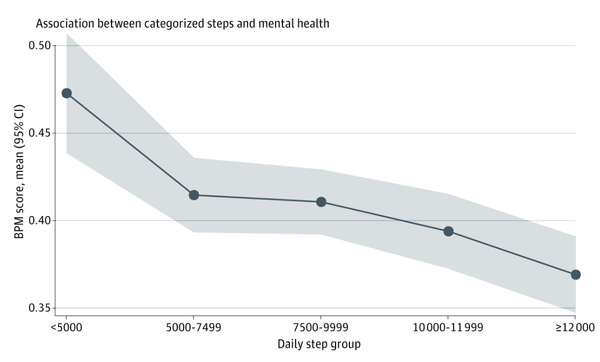
The researchers found that as the children’s step counts grew higher, the increased movement was associated with fewer mental health issues. As shown on the graph below, the more steps per day, the lower the behavioral problem (BPM) score (e.g., less than 5,000 steps per day compared to 7,500-9999 steps per day).
Presuming that this short-term measure of steps demonstrated a consistently higher level of activity over time, the research team also reported that a higher step count was associated with notable impacts on brain structure. Adolescents who moved more had increased thickness in brain regions that control lower limb function and information processing and response. The significance of this brain structure change remains unclear, but the researchers speculate that greater brain thickness may have health benefits for years to come.
For adolescents, there are clear immediate benefits from incorporating movement into daily routines, starting at a young age. Oklahoma recently passed a bill requiring 40 minutes of recess time a day for elementary school students, and proposed legislation in Massachusetts hopes to achieve the same. The prospect of lifelong effects from physical activity during one’s youth will continue to be studied in the Adolescent Brain Cognitive Development study. As the study authors say, “every step counts towards meaningful benefit.”