Why Is Federal Health Data Disappearing?
Executive orders have endangered public health data, with nearly 13% of the CDC’s online datasets disappearing after January 21, 2025.

Read Time: 3 minutes
Published:
Scientific discovery starts with inquiry and depends on reliable data to transform questions into answers. Public health thrives on robust, transparent data collection and reporting. Publicly available health datasets allow scientists to analyze disease trends, identify risk factors, and forecast health outcomes. Their evidence guides clinicians and policymakers in implementing laws and interventions safeguarding health. But when health data vanishes, so does our ability to protect people.
This year, presidential executive orders directly endangered public health data. A recent analysis from Janet Frelich and associates revealed that the Centers for Disease Control and Prevention (CDC) and Health and Human Services (HHS) removed 203 online datasets between January 21 and February 11, 2025. Using the CDC’s public data portal, the researchers tracked data availability through March 2025. They recorded changes by comparing the current datasets to how they looked on January 1 and used the Internet Archive to double-check any data published before 2025.
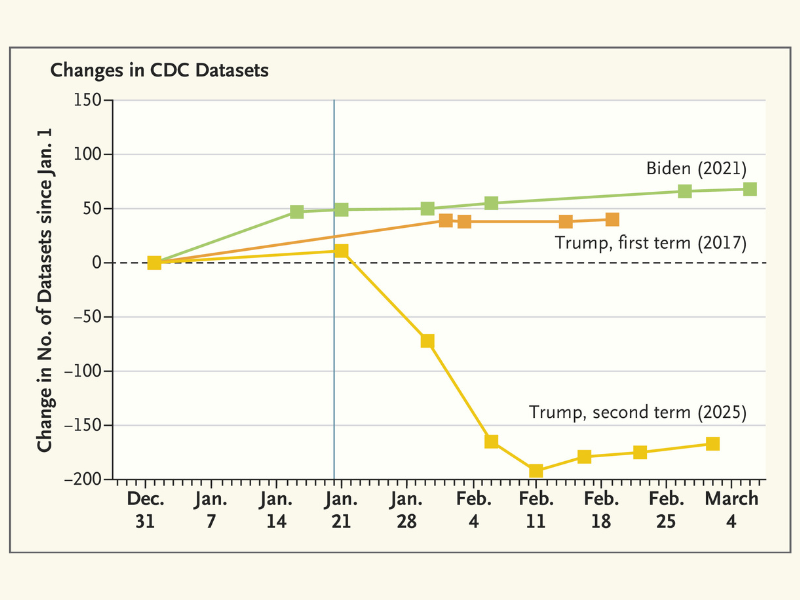
Nearly 13% of the CDC’s online datasets disappeared after January 21, 2025 (shown in the graph above). Some data has been restored after court filings, but others have returned with altered terminology. The CDC restored the Social Vulnerability Index (a useful tool for disaster and emergency planning) on February 11, 2025, only after a federal judge’s order to restore vital health information. The CDC also restricted access to the Pregnancy Risk Assessment Monitoring System and stopped collecting new data, which prevented researchers from analyzing timely trends in maternal and infant mortality.
In one instance, a dataset on county-level heart disease mortality returned with “gender” replaced by “sex.” This replacement rejects the diversity of gender identities and makes it considerably harder to conduct health disparities research. By March, datasets with gender information were most affected under the administration’s anti-DEI directive to remove any public-facing information that promotes gender ideology. Notably, gender data was untouched by Biden or Trump’s first administration.
The CDC and HHS are two of the largest hosts of comprehensive health information, making their lack of data integrity especially alarming. On February 4, 2025, Doctors for America sued the federal agencies for removing data on infectious diseases, LGBTQ+ care, and reproductive and fertility care. The lawsuit was successful in restoring data and deemed it unlawful to take down public health information without explanation.
But this incursion on health data has violated the fundamental principle of freedom of information, and will have far-reaching impacts on research and the policies that follow. Scientists will be forced to rely on non-government data sources, which can be costly and weaken the rigor of their findings. Ensuring the free flow of health data is essential to generate timely health reports and to ensure the public remains informed and protected. Without transparent data, we can’t track disease, hold institutions accountable, or protect the health of our democracy.