When Food Stamps Fall Short
When SNAP work requirements were reinstated in 2016, coverage losses were likely driven by administrative barriers rather than workforce gains.

Read Time: 3 minutes
Published:
The Supplemental Nutrition Assistance Program (SNAP) is the nation’s largest food assistance program. Established in 1964, the program was created to reduce hunger among low-income communities. Each month, nearly 42 million Americans rely on SNAP benefits to afford meals and groceries.
SNAP has long required stable employment for healthy adults without dependents, mandating 20 hours of work weekly to maintain eligibility. Supporters argue work requirements promote employment and “self-sufficiency” while directing benefits to those most in need. States can apply to temporarily waive these requirements during periods of economic hardship, as Connecticut did in 2009 due to an unprecedented 8.4% unemployment rate.
But in 2025, the One Big Beautiful Bill Act made major revisions to SNAP. The bill tightened work requirements nationwide, restricting waivers to states with unemployment above 10% and removing exemptions for veterans, unhoused people, and foster care youth. The changes will likely make qualifying for benefits even harder for many Americans.
A recent study examining safety-net program enrollment in Connecticut after its SNAP waiver expired in 2016 offers insight into how federal work requirements might affect beneficiaries. The researchers tracked 81,888 Medicaid beneficiaries (aged 25-49, without dependents or work exemptions) who were eligible for SNAP between 2015 and 2018. They also tracked Medicaid status to see whether beneficiaries disenrolled after gaining employment to qualify for SNAP.
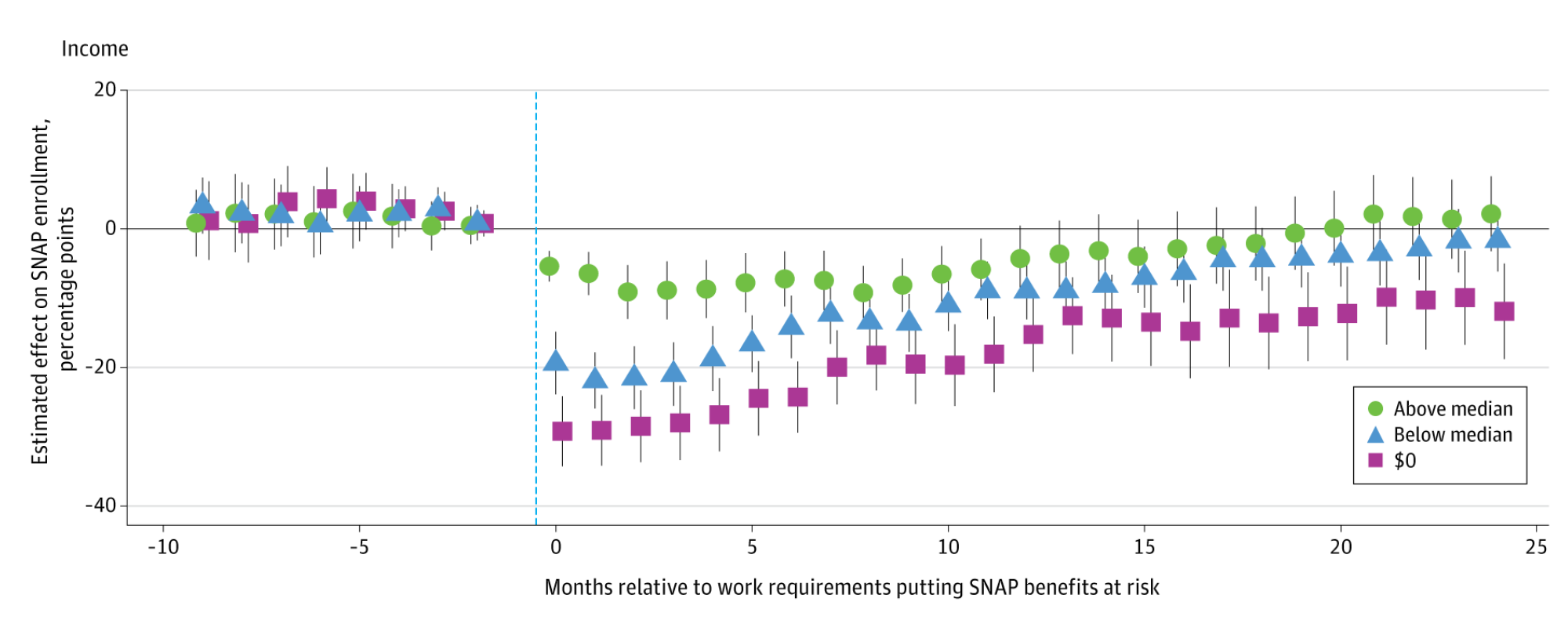
Connecticut reinstated work requirements in April 2016, after which SNAP enrollment declined by 25%. The coverage loss was not evenly distributed, falling most heavily on adults with clinical and socioeconomic vulnerabilities. As seen above, adults with a net-zero income (in purple) were twice as likely to lose SNAP access as those earning above the median (in green).
Disparities were even more pronounced among older adults with health needs. Adults aged 40-49 with multiple chronic conditions were five times more likely to disenroll than younger, healthier beneficiaries. The coverage loss persisted for nearly two years, and fewer than one in four adults reenrolled the following year.
SNAP work requirements also did not reduce Medicaid enrollment in Connecticut, which would be expected if adults secured employment and transitioned off public insurance. Instead, the findings suggest coverage losses were likely driven by administrative barriers rather than by sustained workforce gains.
The study authors urge policymakers to reconsider strict requirements and broaden exemptions to include adults with chronic health needs, particularly as the working-age limit rises to 64. If the goal is to promote self-sufficient Americans, policies must strengthen pathways to work without undermining access to the basic nutrition that makes work possible.