Implicit Advertising Turned Us Against Universal Health Care
By flooding digital spaces with fearmongering and misleading ads, private industry actors influence voter perceptions and policy debates.

Read Time: 4 minutes
Published:
Imagine scrolling through Instagram and coming across a seemingly ordinary ad. It warns of higher taxes, longer wait times, and even hospital closures. What looks like a public service announcement may be part of a multimillion-dollar marketing campaign launched to shape discourse about health care reform.
This playbook dates back decades: in 1993, the Health Insurance Association of America sponsored the famous “Harry and Louise” television ads. Featuring an ordinary American couple, the campaign swayed public opinion and helped derail President Clinton’s proposal for universal health care. Today’s digital equivalents carry similar messages, revealing how private industries continue to influence health care reform.
Despite spending more on health care than any other wealthy nation, the United States’ health outcomes consistently rank among the worst. In 2023, health care spending averaged $13,342 per person, nearly $4,000 more than in other high-income nations. Yet over 27 million Americans remain uninsured and millions more underinsured, leaving many vulnerable to preventable illness, financial distress, and premature death. The U.S. remains the only high-income country without universal health care. The recent government shutdown, driven partly by rising health insurance premiums, has placed health care reform at the center of national policy debates.
Proposals like Medicare for All and universal health care offer promising solutions, though the U.S. is still far from achieving full coverage. For private insurers and hospital groups, these reforms present a looming threat to profit. To defend their interests, industry coalitions such as the Partnership for America’s Health Care Future (PAHCF) have launched sophisticated digital campaigns to influence public opinion nationwide.
Across all ads, the goal remained consistent: to present private industry as the rational choice for American health care, and government reform as a reckless gamble.
A recent study from Kendra Chow and associates examined PAHCF’s marketing strategies to better understand its campaign against universal health care. The researchers identified 1,675 paid advertisements across Instagram and Facebook from May 2018 to September 2021. Some ads are presented below. By analyzing metadata, visuals, and text, the researchers explored how targeted advertising reshaped the health care narrative.
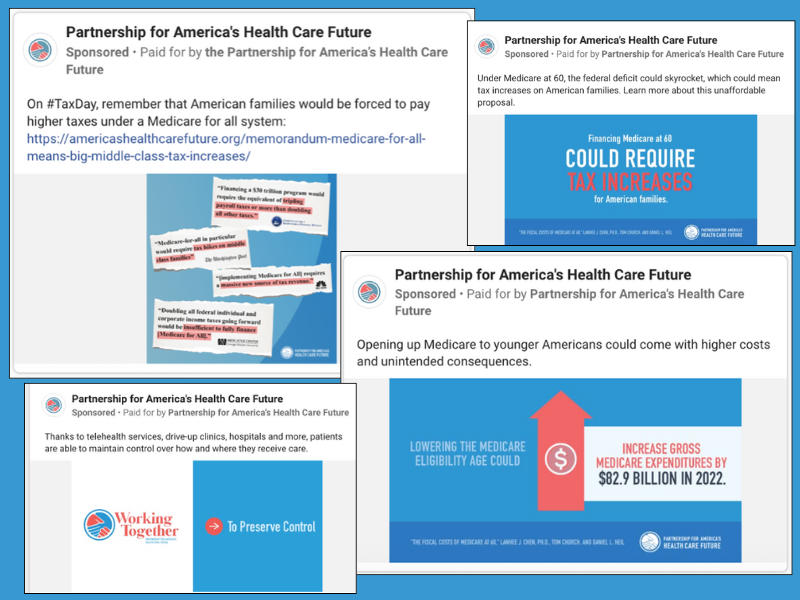
While the ads varied in tone and style, several core themes emerged. More than half were fear-driven, warning that universal health care would raise costs, reduce quality, and increase wait times—summed up in one claim that it would make Americans “pay more, to wait longer, for worse care.” Others emphasized autonomy, framing universal health care as a one-size-fits-all system that would divest people’s health autonomy into the hands of bureaucrats. Another subset cast themselves as “truth-tellers,” using government distrust and negative language to paint universal systems as harmful.
Some ads took a friendlier, solutions-oriented approach, calling for partnerships between private and public programs to “fix what’s broken” without dismantling the existing system. Finally, emotion-driven ads tapped into shared COVID-19 anxieties and argued that all Americans deserved quality care. By making broad statements about “what everyone wants,” PAHCF sought to create collective unity against universal systems.
When health reform debates play out through ads instead of evidence, the public’s trust and health become casualties.
Across all ads, the goal remained consistent: to present private industry as the rational choice for American health care, and government reform as a reckless gamble. The PAHCF spent close to $1.1 million on advertisements, amassing over 40 million impressions from Facebook and Instagram users. But on the contrary, evidence suggests that adopting universal coverage in the U.S. could reduce national health spending by 13%, saving roughly $438 billion per year.
While no system is perfect (countries like the UK and Canada face their own challenges), many Americans have embraced the Affordable Care Act (ACA). Although far from universal coverage, the ACA has expanded insurance access and made health care more affordable for millions. Letting its subsidies expire could reverse these gains and impose financial hardship on families.
The public health stakes of these campaigns are high. By flooding digital spaces with fearmongering and misleading claims, private industry actors influence voter perceptions and policy debates. Disinformation of this kind does more than distort political opinion—it deepens existing inequities, delays reform, and perpetuates preventable suffering. Addressing implicit messaging will require stronger regulation of political advertising and a greater investment in public health literacy. When health reform debates play out through ads instead of evidence, the public’s trust and health become casualties.