Cancer In the Shadow of Nuclear Plants
The promise of a cleaner, nuclear-powered grid must be weighed alongside the health of the communities living near these facilities.
Read Time: 4 minutes
Published:
I grew up in Plymouth, Massachusetts, about 3 miles away from the Pilgrim Nuclear Power Plant. Occasionally, the town would test the warning system. Out of the blue, a deafening, disembodied voice would announce: “Attention. Attention. This is a test of the emergency siren system. This is only a test.” A whining blare would follow. In the event of an accident, this was a signal for residents to get in their cars and flee. I used to imagine the entire population of Plymouth sitting in gridlock traffic on Route 44 as our bodies filled with radiation. Otherwise, I mostly forgot the plant existed.
No accidents occurred, and the Pilgrim plant ceased operations in 2019, part of a broader trend of reactor retirements across the United States over the past few decades. Disasters like Three Mile Island in 1979, Chernobyl in 1986, and Fukushima in 2011 loom large in our collective imagination, due to mass evacuations, environmental contamination, and global media coverage. However, in reality, nuclear accidents are incredibly rare.
But focusing only on catastrophic meltdowns obscures a less prominent concern: the routine, low-level releases that occur during normal plant operations. Even when they are functioning properly, nuclear facilities discharge small amounts of radioactive materials that can contaminate surrounding water, air, soil, and crops. Radiation exposure damages the DNA within our cells, causing them to mutate or die. Over long periods, even exposures considered low by international safety standards have been associated with multiple types of cancer, including breast, bladder, and thyroid.
The promise of a cleaner grid and greater energy independence must be weighed alongside the health of the communities living near these facilities.
When I think about it, several of my neighbors have died of cancer over the past 20 years. That observation is purely anecdotal, and cancer is unfortunately common; about 40% of Americans will be diagnosed at some point in their lives. Still, I was struck when I came across a recent study by Yazan Alwadi and colleagues that examined cancer clusters around nuclear power plants that included data from my hometown. The researchers used 18 years of Massachusetts cancer registry data to analyze the geographic distribution of cancer cases. They focused on both total cancer cases and specific types of cancer in relation to the seven nuclear power plants located within 120 kilometers of Massachusetts residents.
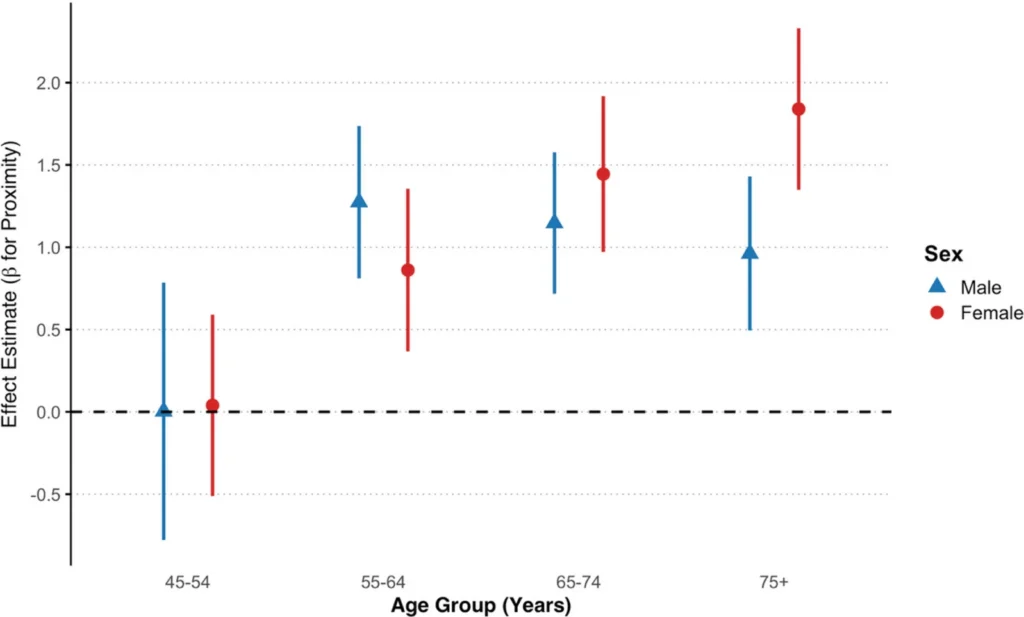
Between 2000 and 2018, 20,618 cancer cases in Massachusetts (about 3 to 4% of total cases) were attributable to nuclear power plant exposure, including lung, prostate, colorectal, melanoma, leukemia, thyroid, uterine, and bladder cancers. Among people over 55, those living closest to a plant had roughly 1.75 to 2 times the risk of developing cancer compared with those living farther away (shown in the figure below). The pattern was consistent across the plants included in the analysis. Risk was highest within a few kilometers radius, dropped sharply at about 5 kilometers (3.1 miles), and was nearly negligible beyond 25 kilometers (15.5 miles). The zip code with the highest excess risk was 02360—my zip code.
Findings like these matter because the United States is actively reconsidering the role of nuclear power in its energy future. Since the 1990s, the number of operational nuclear reactors in the U.S. has decreased from 112 to 93, but that trend is starting to reverse course. We are the largest producer of nuclear power in the world, with nuclear generating around 20% of our electricity, and half of our carbon-free electricity.
In recent years, federal policy from both Democrats and Republicans has shifted toward expansion. The Inflation Reduction Act of 2022 created financial incentives such as tax credits to keep existing reactors online and support new development, while an executive order from President Donald Trump streamlined licensing and called for the country to quadruple nuclear energy production by 2050.
The U.S. needs a clear strategy for its energy transition, one that balances the need to move away from fossil fuels to curb the effects of climate change with the reality of rising electricity demand. Power consumption is projected to increase by 40-50% by 2040, driven in part by the rapid expansion of artificial intelligence, cloud computing, and data centers.
In that context, nuclear power is attractive: it produces steady, carbon-free electricity. But this promise of a cleaner grid and greater energy independence must be weighed alongside the health of the communities living near these facilities.